What Are the Disadvantages of Solar Panels in Singapore? An Honest List for Landed Homeowners
Upfront cost, night-time, weather, shade, roof works, inverter replacement, blackouts: ten honest downsides of home solar in Singapore, how much each really matters, and what to do about it.
Written by Isaac, Sales Engineer. Reviewed by Justin Tan, Lead Engineer. Last verified 4 October 2026.
The quick answer: Rooftop solar has real downsides in Singapore. It costs about S$1,200 to S$2,000 per kWp to install on a landed home, it produces nothing at night, surplus power exported to the grid is credited at about 22 cents per kWh while grid power costs about 31 cents, output dips in rainy weeks and under shade, and the inverter usually needs replacing once over the panels' 25 to 30-year life. None of these is hidden and most can be reduced by good design. For a typical unshaded landed roof, bill savings still recover the system cost in around 3 to 6 years.
Key facts (last verified 4 October 2026)
- Typical installed cost, landed homes: S$1,200 to S$2,000 per kWp (Rezeca 2026 range).
- Typical yield: 1,100 to 1,350 kWh per kWp per year, varying with shade, orientation and weather.
- Power you buy: 31.16 cents/kWh incl. GST; power you export under SCT: about 22 cents/kWh (1 Oct to 31 Dec 2026).
- Panel warranties: commonly 25 or 30 years; inverter warranties: commonly 5 or 10 years, often extendable.
- Estimated payback, typical landed home: 3 to 6 years (estimate, method below).
Why write about the downsides at all?
Because they are what homeowners ask about once the sales pitch is over, and the answers change the decision. Solar is a 25-year purchase. It is better to go in knowing where it falls short, how big each shortfall is on a Singapore roof, and what a good design does about it. Below are the ten Rezeca hears about most, roughly in order of how much they matter.
| Disadvantage | How much it matters in Singapore | What reduces it |
|---|---|---|
| 1. Upfront cost | High. The largest single barrier. | Size to your usage, compare quotes line by line, consider instalments. |
| 2. No power at night | Medium. Night use is bought from the grid. | Shift loads to daytime; battery only if backup matters to you. |
| 3. Export worth less than import | Medium. About 22 cents vs about 31 cents per kWh. | Size for self-consumption rather than maximum roof coverage. |
| 4. Cloud and rain | Low to medium. Month-to-month swings, steady year to year. | Judge output annually, not weekly. |
| 5. Shade | Varies. Can be the deciding factor. | Shade survey; panel layout; shade-tolerant back-contact panels. |
| 6. Roof works and leaks | Medium. Depends on roof type and installer. | Correct mounting for the roof type; clear waterproofing responsibility. |
| 7. Heat | Low. A known, modest efficiency loss. | Ventilated mounting; panels with a good temperature coefficient. |
| 8. Inverter replacement | Low to medium. Usually once in the system's life. | Budget for it; extended warranty; accessible mounting. |
| 9. Maintenance and birds | Low. Mostly cleaning and occasional bird-proofing. | Periodic inspection; bird mesh where pigeons nest. |
| 10. No backup in a blackout | Low for most homes. Outages are rare and short. | Hybrid inverter and battery if you need backup. |
1. Is the upfront cost the biggest disadvantage?
For most households, yes. A landed-home system typically costs about S$1,200 to S$2,000 per kWp installed in 2026, with larger systems at the lower end per kWp and small terrace systems at the higher end. There is no government grant to offset it. The cost is recovered through lower bills, typically over 3 to 6 years, but it is still money spent on day one.
What reduces it: size the system to your consumption rather than your whole roof, and compare quotations on the same basis (kWp, panel and inverter model, warranties, what is included). Rezeca's 2026 price guide has typical totals by house type. If spreading the cost matters more than the total, see Rezeca's comparison of rent-to-own and ownership.
2. Solar produces nothing at night. How much does that matter?
Panels generate from roughly sunrise to sunset, peaking around midday. Anything you use after dark, such as bedroom air-conditioning, still comes from the grid at the full tariff. Solar reduces your bill; it rarely eliminates it.
What reduces it: run flexible loads in daylight where you can, such as the washing machine, water heater, pool pump or EV charging on a timer. A battery can store daytime surplus for the evening, but in Singapore the saving from doing so is small, so batteries mostly make sense for backup rather than return. Rezeca's battery guide explains why.
3. Why is exported solar worth less than grid power?
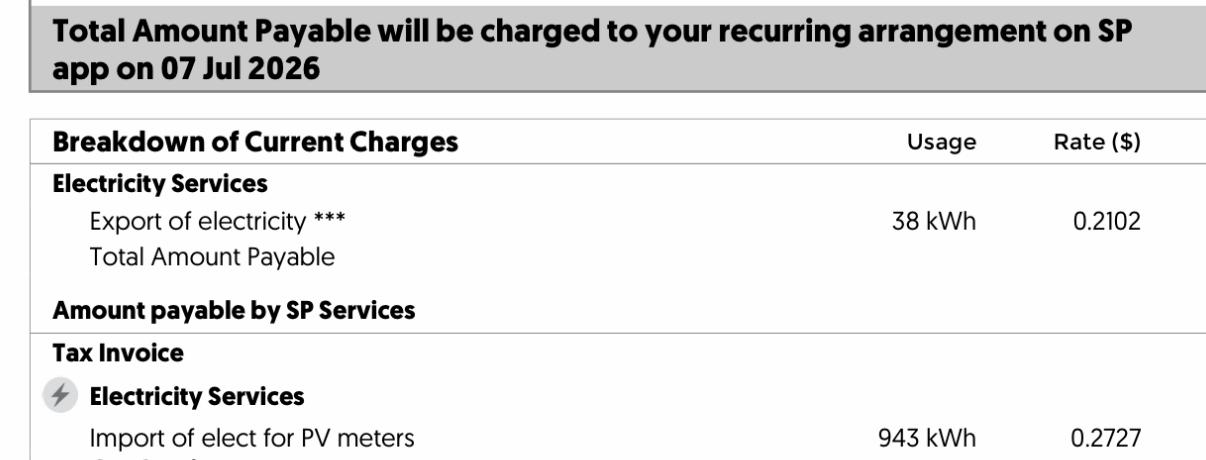
Under the Simplified Credit Treatment (SCT), surplus solar is credited at the regulated tariff less the grid charge, about 22 cents per kWh in October to December 2026, while power you buy costs 31.16 cents including GST. So each unit you export is worth roughly a quarter less than a unit you use yourself.
What reduces it: aim for a high share of self-consumption. A system sized to your daytime use earns more per kWp than one that covers every square metre of roof and exports most of its output. Rezeca's system sizing guide covers the trade-off.
4. Does Singapore's cloud and rain make solar unreliable?
Output varies day to day and month to month. A run of heavy, overcast monsoon days can pull generation well below a clear week, and haze reduces it further. Over a full year, though, Singapore is consistent: roofs typically generate 1,100 to 1,350 kWh per kWp, and panels still produce on overcast days, just less. See do solar panels work on cloudy and rainy days.
What reduces it: judge performance on annual totals, and make sure your quotation's generation estimate states its assumptions.
5. How much does shade cut output?
More than most people expect. Trees, a neighbour's taller house, a water tank or a parapet can shade part of an array for hours a day, and on a standard string inverter one shaded panel can hold back the others wired with it. On some roofs, shade is the difference between a good investment and a mediocre one.
What reduces it: a proper shade assessment at the site visit, a layout that avoids the worst areas, and panels built to tolerate partial shade, such as back-contact (ABC) modules, with optimisers kept for heavily shaded roofs. Rezeca's roof self-assessment helps you spot shade issues before a visit.
6. Can solar panels damage the roof or cause leaks?
The panels themselves do not. Problems come from installation: poorly sealed fixings, cracked tiles, or mounting that is wrong for the roof type. The other roof-related downside is timing. If you plan to re-roof, waterproof or rebuild in the next few years, panels will need to come off and go back on, which adds cost.
What reduces it: mounting designed for your roof (tile hooks, metal roof clamps, or ballasted frames on flat RC roofs that avoid drilling the waterproofing), a clear statement of who is responsible for waterproofing, and a workmanship warranty. Plan solar around roof works you already expect. Rezeca's roof types guide covers what each roof needs.
7. Does Singapore's heat reduce solar efficiency?
Yes, modestly. Panels are rated at 25°C and lose a little efficiency for every degree hotter they run, and a Singapore roof at midday is well above that. It is already reflected in realistic yield figures like the ones above, so it is a reason to be wary of estimates based on overseas conditions rather than a reason to avoid solar. More in Rezeca's guide to solar in Singapore heat.
8. Will the inverter need replacing?
Probably once. Panels commonly carry 25 or 30-year warranties and lose output slowly, typically well under 1% a year. The inverter is the working electronics and usually carries a 5 or 10-year warranty, often extendable, so it is sensible to budget for one replacement over the life of the system. Because string inverters are wall-mounted, replacement is a straightforward job. Rezeca's maintenance guide covers typical costs.
9. What maintenance does solar need?
Not much, but not nothing. Rain does most of the cleaning, but bird droppings, leaf litter and dust can build up, especially on low-tilt panels. Pigeons sometimes nest in the gap under panels, which is messy and can damage cabling. An annual inspection and occasional cleaning keep output where it should be, and bird mesh around the array edge solves the nesting problem. See Rezeca's maintenance guide.
10. Does solar keep my lights on in a blackout?
Not on its own. A standard grid-connected system shuts down automatically when the grid goes down, so no power is fed onto lines that engineers may be working on. Keeping circuits running needs a battery and a backup-capable hybrid inverter. Grid outages in Singapore are rare and usually short, so most households do not find this worth paying for. Details in does solar work during a power outage.
Who should not install solar?
Solar is a poor fit, or at least a slower payback, if any of these apply:
- Your roof is heavily shaded for much of the day.
- You use very little electricity, especially in daylight hours.
- You plan to rebuild the house or replace the roof within a few years.
- You live in an HDB flat or condominium, where the roof is common property. Rezeca's guide to who can install solar in Singapore explains the options.
An honest installer should tell you if your roof falls into one of these groups. Rezeca's guide to choosing a solar installer lists the questions that bring that out.
So, do the advantages outweigh the disadvantages?
For most landed homes with a reasonably clear roof, yes, and by a good margin. The disadvantages above are mostly about timing and design rather than whether solar works. With the tariff at 31.16 cents per kWh and typical yields of 1,100 to 1,350 kWh per kWp, a well-sized system typically recovers its cost in 3 to 6 years and then keeps cutting bills for another two decades. The full numbers are in is solar worth it in Singapore.
How these figures were worked out
- Cost range: Rezeca's 2026 installed range for landed homes, S$1,200 to S$2,000 per kWp. Actual prices depend on system size, roof type and components.
- Yield: 1,100 to 1,350 kWh per kWp per year, the range Rezeca uses across its guides, from installed-system performance in Singapore.
- Tariff and SCT rate: SP Group release for 1 Oct to 31 Dec 2026. Rates are revised quarterly.
- Payback of 3 to 6 years is an estimate assuming 50 to 70% self-consumption, S$0.31/kWh self-consumed and S$0.22/kWh exported. It is not a quotation.
Sources: SP Group tariff information, Q4 2026 · EMA forum reply on SCT and ECIS, Jan 2025
Frequently asked questions
What are the main disadvantages of solar panels in Singapore?
The main ones are the upfront cost, typically about S$1,200 to S$2,000 per kWp installed for a landed home; no generation at night; exported power being credited at about 22 cents per kWh against about 31 cents for power you buy; output that varies with cloud, rain and shade; roof works to plan around; and an inverter that will usually need replacing once during the panels' life. For most unshaded landed roofs these are outweighed by bill savings, with payback typically in 3 to 6 years.
Do solar panels cause roof leaks?
Well-installed panels should not. Leaks come from poorly sealed roof penetrations or damaged tiles during installation, not from the panels themselves. Ask how your installer fixes the mounting to your roof type, who is responsible for waterproofing, and what warranty covers it. On flat RC roofs, ballasted or non-penetrating mounts can avoid drilling through the waterproofing layer.
Do solar panels work during a power outage in Singapore?
A standard grid-connected system switches off automatically during a grid outage, for the safety of engineers working on the lines. To keep some circuits running during an outage you need a battery with a backup-capable hybrid inverter. Outages in Singapore are rare and usually short, so most households treat backup as optional.
Why do some people remove their solar panels?
In Singapore the usual reasons are practical: re-roofing, a major renovation or rebuild of the house, or an old system reaching the end of its inverter life. Panels can normally be removed and reinstalled, at a cost, so it helps to plan solar around any roof or rebuilding works you already expect.
Is solar worth it despite the disadvantages?
For most landed homes with a reasonably unshaded roof and meaningful daytime electricity use, yes. Singapore roofs typically generate 1,100 to 1,350 kWh per kWp each year and the regulated tariff was 31.16 cents per kWh including GST in October to December 2026. Solar is harder to justify on heavily shaded roofs, very low-use homes, or houses due for rebuilding within a few years.
Want an honest read on your own roof?
Rezeca Renewables has designed and installed solar in Singapore since 2009, with 1,500+ installations and 45+ MWp to date and a 4.9-star customer rating. At the site visit Rezeca will tell you which of these downsides apply to your roof, how much they cost you in kWh, and whether solar makes sense for you at all.
Considering solar for your Singapore home?
Rezeca offers a free on-site assessment, no-obligation quotes, and full 25-year ROI projections based on your actual property. Own your system outright or finance it through UOB U-Solar, backed by 17 years of experience and 1,300+ landed-home installations.
Estimate your savingsWhatsApp:+65 9839 9044 | Email:enquiry@rezeca.com
Get Your Custom
Solar Plan
Prefer to chat? Tap the WhatsApp icon below to reach our team instantly.

Copyright © 2026 Rezeca Renewables.