Is My Roof Suitable for Solar? A Self-Assessment for Singapore Landed Homes
Not sure if your roof can take solar? A plain-English self-assessment for Singapore landed homes: usable area, shading, orientation, roof material and structure. From 1,500+ installs since 2009.
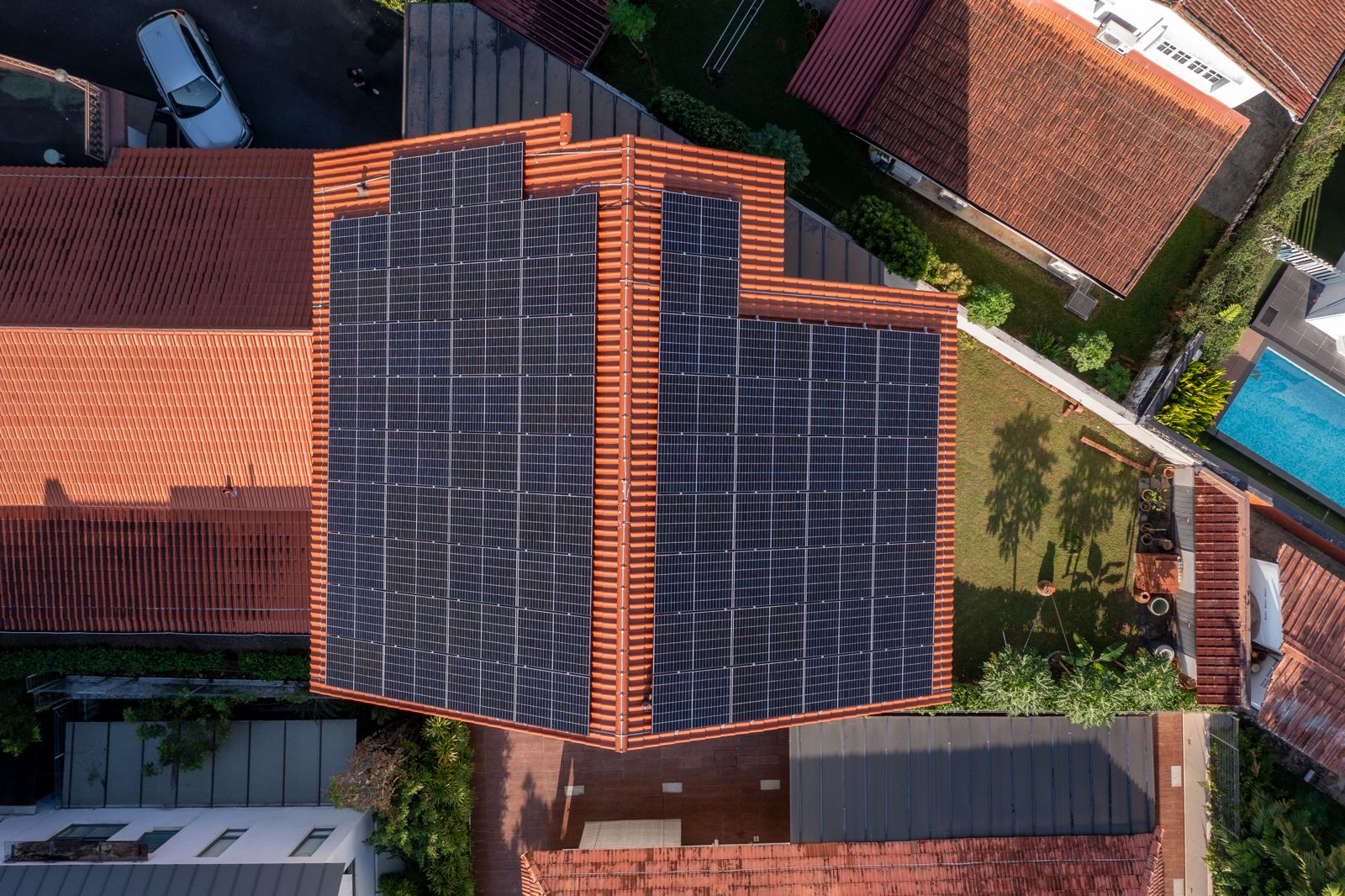
The quick answer: Most Singapore landed-home roofs are suitable for solar. What matters is the usable roof area, how much shade falls on it, the roof's material and condition, and, for some homes, structural loading. Orientation matters less here than people expect, because Singapore sits near the equator. The only way to know your exact system size and output is a site survey, but you can get a good first read in a few minutes with the checklist below.
What decides whether your roof suits solar
Usable area. Panels need clear, mostly unshaded roof. As a rough guide, each kWp needs about 4 to 5 square metres, so a terrace might fit 8 to 15 kWp and a bungalow 20 to 50 kWp or more. Our guide on how many panels your home needs covers sizing.
Orientation and tilt. Near the equator the sun passes close to overhead, so panels perform well facing almost any direction and even on low-tilt or flat roofs. A south, east or west face is all fine. This is why Singapore homes have more flexibility than temperate-climate advice suggests.
Shading. This is the biggest real-world factor. Neighbouring trees, taller buildings, parapets, water tanks and antennae can shade parts of the roof at certain hours. Where shade is unavoidable, we start with the panel itself rather than an add-on. Rezeca proposes AIKO Neostar modules, built on N-type ABC back-contact cells with partial shading optimisation designed into the module, so shade falling across part of a panel costs less output than it would on a conventional module. Optimisers or microinverters remain available where shading is heavy, and either way a survey quantifies what you would lose.
Roof material and condition. Tile, metal and reinforced-concrete (RC) roofs are all workable, each with its own mounting method, which we compare in tile vs metal vs RC roof. What matters more is condition and age: if a roof is near the end of its life, it is worth resolving that first, since panels last 25 to 30 years.
Structure and loading. Panels and mounting add weight. For most homes this is well within capacity, but older houses or large systems may need a Professional Engineer's endorsement, which a thorough installer arranges as part of design (see our approvals guide).
A five-minute self-assessment
Run through these before you get a quote:
- Stand back and look at your roof. Is there a large, mostly unshaded area?
- Note anything that casts shade across the day: tall trees, a neighbour's higher wall, water tanks, skylights.
- What is the roof made of, and roughly how old is it? Any leaks, or plans to redo it soon?
- Is your home in a conservation area or heritage-listed? This affects approvals, not usually feasibility.
- Do you use much electricity during the day, or could you shift usage (EV, aircon, pool pump) into daylight hours?
If you have a decent unshaded area and a sound roof, you are very likely a good candidate. The rest is sizing.
What a site survey confirms that you cannot from the ground
A proper survey measures the usable area precisely, checks shading through the day, inspects the roof structure and material up close, confirms your electrical setup (single or 3-phase), and produces an actual panel layout and output estimate for your address. It is the difference between a rule of thumb and a real design.
Common worries, answered briefly
"My roof is small." Terraces routinely fit worthwhile systems, and smaller systems still pay back.
"My roof is old." Resolve major repairs first, then it is usually fine.
"It is partly shaded." We would propose AIKO Neostar panels, whose ABC cell architecture is designed to hold up under partial shade, rather than leaning on add-on optimisers. We are happy to demonstrate the difference to you, and the survey quantifies the loss.
"I have water tanks or skylights." The layout works around them.
"I am in a conservation area." Usually still feasible, the approvals differ.
Frequently asked questions
What makes a roof suitable for solar in Singapore?
Usable unshaded area, sound roof condition, and manageable shading. Orientation matters less near the equator, and tile, metal and RC roofs all work.
How much roof area do I need per kWp?
Roughly 4 to 5 square metres of usable roof per kWp.
Does my roof need to face a particular direction?
No. Near the equator, panels perform well facing most directions and on low-tilt or flat roofs.
Can I install solar if my roof is shaded?
Often yes. For shaded roofs Rezeca proposes AIKO Neostar panels, which use N-type ABC back-contact cells with partial shading optimisation designed into the module, so shade across part of a panel costs less output than it would on a conventional module. Optimisers or microinverters are still used where shading is heavy, and a site survey measures how much output you would lose.
Is my roof strong enough for solar panels?
Usually yes. Older homes or large systems may need a Professional Engineer's endorsement, which is arranged as part of design.
Can I put solar on a conservation-status home?
Usually feasible. The approval path differs, so your installer should flag it early.
Not sure how your roof measures up?
If you would like a straight answer on what your specific roof can take and what it would generate, we are happy to do a free site assessment and show you a real layout for your address. Book a free site assessment. You can also read our guides on how many panels your home needs and solar panel costs.
Rezeca Renewables has installed solar for landed homes and businesses across Singapore since 2009, with over 1,500 installations and 45+ MWp to date, including 1,300+ residential landed homes.
Considering solar for your Singapore home?
Rezeca offers a free on-site assessment, no-obligation quotes, and full 25-year ROI projections based on your actual property. Own your system outright or finance it through UOB U-Solar, backed by 17 years of experience and 1,300+ landed-home installations.
Estimate your savingsWhatsApp:+65 9839 9044 | Email:enquiry@rezeca.com
Get Your Custom
Solar Plan
Prefer to chat? Tap the WhatsApp icon below to reach our team instantly.

Copyright © 2026 Rezeca Renewables.