Solar Approvals in Singapore: LEW, SP Group, SCDF and URA (2026 Homeowner Checklist)
Who actually approves home solar in Singapore? A plain-English guide to LEW, SP Group, SCDF and URA, what your installer handles and what you don't. From 1,500+ installs since 2009.

The quick answer: For a typical Singapore landed home, you personally handle almost no paperwork. Your installer's Licensed Electrical Worker (LEW) submits the electrical application and registers your system with SP Group. You generally do not need URA planning permission (as long as your home is not in a conservation area), and you only deal with SCDF if you add a battery larger than 20 kWh. From installation start to full commissioning usually takes 4 to 12 weeks, and most of that wait is SP Group's connection timeline, not the installation itself.
"Solar approval" sounds intimidating. It mostly isn't.
The acronyms put people off: LEW, SP Group, SCDF, URA, EMA. It reads like a wall of government counters you will be queuing at on your own.
In practice, for a landed home, almost all of it is handled behind the scenes by your installer and the Licensed Electrical Worker they appoint. The point of this guide is to show you exactly who is responsible for what, so you can tell a thorough installer from a careless one, and know what little actually lands on your plate.
We have built solar for landed homes across Singapore since 2009, more than 1,500 installations, so this is the process as it really runs, not the theory.
Who approves what: the short version
| Body | What it governs | Do you deal with it directly? |
|---|---|---|
| LEW (Licensed Electrical Worker) | The electrical work and the SP Group application | No, your installer appoints the LEW |
| SP Group | Grid connection, metering, sell-back registration, turn-on | No, your LEW submits on your behalf |
| EMA (Energy Market Authority) | National generation-licensing framework | Not applicable for landed homes |
| URA | Planning permission, relevant only in special cases | Usually no |
| SCDF | Fire safety for battery storage | Only if you add a battery larger than 20 kWh |
| Building LEW | Common-property electrical sign-off | Cluster and strata housing only, and not covered under the installer's scope |
| BCA / structural | Roof loading capacity | Handled as part of design |
EMA: not applicable for a landed home
The Energy Market Authority sets the national rules for connecting generation to the grid, but for a home solar system there is nothing you or your installer need to license with EMA. An EMA Generation Licence is only required for facilities of 1 MWac and above, which is utility and large-commercial territory, far beyond any landed home (even a Good Class Bungalow system rarely exceeds around 90 kWp). So if you have read that you "need EMA approval" for home solar, you can set that worry aside: for a landed home it does not apply.
LEW: the one professional every legal solar system must have
A Licensed Electrical Worker is mandatory for every grid-connected solar installation in Singapore, regardless of size. The LEW takes legal charge of the electrical work, submits the electrical installation application to SP Group, registers your system for sell-back, and certifies the system safe before it connects to the grid.
You do not hire an LEW separately. A proper installer either employs one or engages one for your project. This is the clearest test of an installer you have: if a company cannot name the LEW responsible for your job, or suggests skipping the SP registration to "save time," that is a red flag. You can verify any LEW on EMA's ELISE portal before work begins. Choosing carefully matters, and our guide on how to choose a solar installer in Singapore goes deeper.
SP Group: grid connection, metering and getting paid for what you export
SP Group owns the connection to the grid, so this is where the real timeline lives.
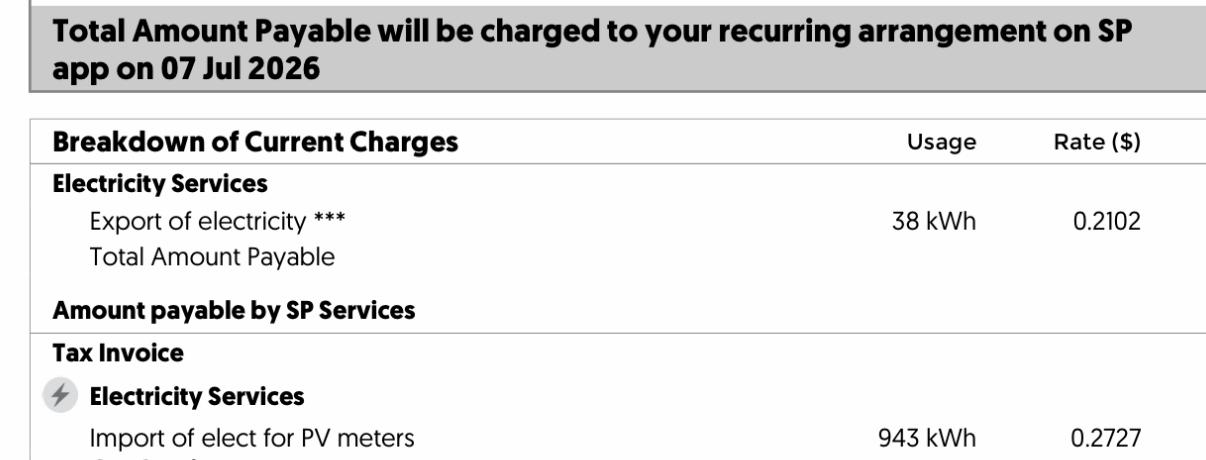
Your LEW submits the electrical installation application and registers your system under the Simplified Credit Treatment (SCT) scheme. SCT is the standard arrangement for homes and is available for any solar system under 1 MWac. Under SCT, the electricity you export to the grid is credited on your monthly bill at the prevailing regulated tariff minus grid charges (around 22 cents per kWh for October to December 2026), reviewed every quarter.
A practical point worth setting expectations on: SP Group's processing and metering work is the main reason the whole journey from installation start to full commissioning usually takes 4 to 12 weeks, even though the physical installation on your roof takes only 1 to 2 weeks. That portion of the wait is the utility's timeline, not something any installer controls, and an honest installer will tell you that up front.
URA: usually nothing to do
Good news for most landed homeowners: installing solar panels on your roof does not require URA planning permission, as long as your home is not in a Conservation Area and is not subject to special urban-design guidelines. Planning permission becomes relevant mainly for conservation or protected properties. If you own a conservation-status or heritage home, this is worth checking early, and your installer should flag it during the site survey.
SCDF: only if you add a battery above 20 kWh
For a standard solar-only system, SCDF approval is not required for a typical landed home. It comes into play only if you add battery storage (an Energy Storage System) larger than 20 kWh. Above that threshold, SCDF's Fire Code sets out fire-safety requirements, covering stored-energy limits, a battery management system that can isolate the battery, an accessible emergency shut-off, and minimum spacing. If a battery of that size is part of your plan, your installer designs and documents the system to those requirements. Whether a battery is worth it at all is a separate question, covered in our solar batteries guide.
Building LEW: cluster and strata housing only
If your home is part of a cluster or strata development with shared common property and an MCST, a separate Building LEW sign-off may be required for the common electrical infrastructure, on top of the LEW work for your own unit. This is specific to cluster and strata housing and is not covered under the installer's scope, so it is arranged by the development's MCST or managing agent rather than by Rezeca. For a standalone landed home, it does not apply.
BCA and structure: can your roof take it?
This is not a permit you apply for, but it is part of a responsible design. Solar panels and mounting add weight, so your roof's loading capacity is assessed during the site survey, and for some homes, particularly older ones or larger systems, a Professional Engineer's endorsement of the structure is appropriate. A good installer treats this as routine, not an afterthought.
So what do you actually do?
Genuinely, very little. Choose a reputable installer and confirm who their LEW is. Sign the contract and approve the system design. Provide a recent SP Group electricity bill and account details so your LEW can file the connection application, and be available for the site survey and the switch-on. Everything else, from the SP application and SCT registration to structural checks and any SCDF documentation for a large battery, is handled for you.
The honest timeline
| Stage | Typical duration |
|---|---|
| Site survey and system design | A few days |
| LEW submits SP application and registers SCT | Built into the SP wait |
| Installation on site | 1 to 2 weeks |
| SP Group processing, metering and turn-on | The bulk of the wait |
| Installation start to full commissioning | Typically 4 to 12 weeks (SP-dependent) |
Frequently asked questions
Do I need government approval to install solar panels on my landed home?
Not personally, for the most part. There is no licence to apply for on a home-sized system. Your installer's Licensed Electrical Worker files the SP Group connection application on your behalf. You generally do not need URA planning permission either, as long as your home is not in a conservation area.
Do I need EMA approval for home solar?
No. EMA licensing applies only to generation facilities of 1 MWac and above, so for a landed home it is not applicable.
Do I need URA approval for solar panels?
Usually no. Planning permission is required only in specific cases, such as conservation or protected buildings. Standard roof-mounted panels on a typical landed home do not need it.
Do I need SCDF approval for solar panels?
Not for a solar-only system. SCDF requirements apply only if you add battery storage larger than 20 kWh.
What about cluster or strata housing?
Cluster and strata developments may need a separate Building LEW sign-off for common property. That is not part of the installer's scope and is arranged through the MCST or managing agent.
How long does the whole process take?
Typically 4 to 12 weeks from installation start to full commissioning. The installation itself is only 1 to 2 weeks; most of the remaining time is SP Group's connection and metering process, which no installer controls.
Thinking about solar for your home?
If you would like a straight answer on what your roof can take, what you would save, and exactly how the approvals will be handled for your address, we are happy to walk you through it. Book a free site assessment. You can also read our guides on choosing solar by roof type and solar payback periods in Singapore.
Rezeca Renewables has installed solar for landed homes and businesses across Singapore since 2009, with over 1,500 installations and 45+ MWp to date, including 1,300+ residential landed homes.
Considering solar for your Singapore home?
Rezeca offers a free on-site assessment, no-obligation quotes, and full 25-year ROI projections based on your actual property. Own your system outright or finance it through UOB U-Solar, backed by 17 years of experience and 1,300+ landed-home installations.
Estimate your savingsWhatsApp:+65 9839 9044 | Email:enquiry@rezeca.com

All your solar questions, answered
Everything Singapore landed homeowners need to know about solar panel installation, costs, approvals, and returns.
Get Your Custom
Solar Plan
Prefer to chat? Tap the WhatsApp icon below to reach our team instantly.