Can You Put Solar on a Conserved House in Singapore?
Terraces, semi-detached houses, bungalows and GCBs mostly need no URA permission for solar, and conserved houses have a free, two-week route. What actually triggers permission, and how to make an array sit right on the roof.
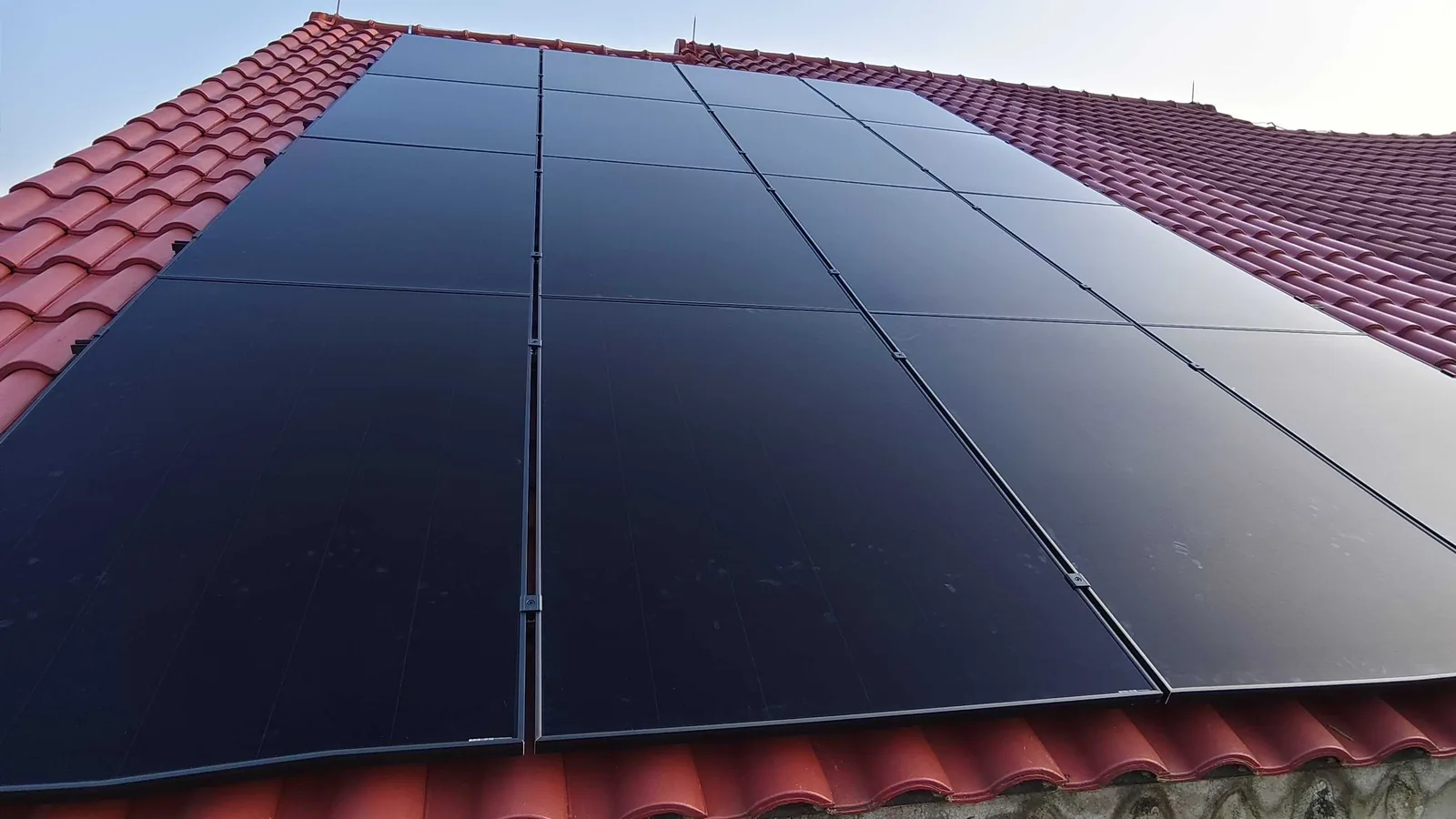
The quick answer: Yes. Most landed homes in Singapore, whether a terrace, a corner terrace, a semi-detached house, a detached house or a Good Class Bungalow, can take solar without any URA planning permission, because a roof-hugging array counts as an ancillary solar installation. Permission is only triggered in three situations: the property is inside a Conservation Area or an area with urban design guidelines, the panels are raised more than 1 metre above roof level, or the space beneath the panels is enclosed or put to another use. Conserved houses, from Emerald Hill terraces and Joo Chiat shophouses to the bungalows of Ridout Park, can take solar too. For a conserved building, panels installed on their own are treated by URA as Category 3 works: an application the owner or contractor can lodge, free of charge, that takes about two weeks. The practical constraint on a heritage roof is almost never the regulation. It is the design: keeping the array off the street elevation, flush to the roof plane, and reversible.
Can you put solar on a landed house in Singapore?
For the great majority of landed homes, yes, and with less paperwork than most owners expect. That applies to terraces and semi-detached houses as much as to bungalows. For a conserved house it is also yes, with one extra, lightweight step.
URA’s guidance on the installation of solar panels, last updated in June 2026, treats panels added to an existing building as an ancillary solar installation, which does not require planning permission except in three stated situations. If your house falls outside those three, the URA step simply does not arise and the approvals that matter are the electrical ones: your Licensed Electrical Worker and SP Group.
This surprises people, because landed housing carries a lot of planning rules: plot size, setbacks, site coverage, storey height, attic and roof profile controls, and for a GCB, some of the tightest controls in Singapore. Owners reasonably assume solar sits under the same scrutiny. In practice, a conventional array laid close to the roof is not treated as new development.
One exception is not about URA at all. If your house is part of a strata landed or cluster housing development, the roof is governed by the MCST’s by-laws, and you will usually need the management corporation’s consent before work starts. It is worth raising early, because a council meeting can take longer than the installation.
When does URA planning permission actually apply?
Three triggers, and they are worth reading against your own house rather than assuming.
| Trigger | What it means for a landed home |
|---|---|
| Conservation Area or an area under urban design guidelines | Planning permission is required, because of the effect on the roofscape. For a conserved building, panels on their own go through the Category 3 route instead. Check the address on URA SPACE before assuming either way. |
| Elevated panels | A panel counts as elevated if it is raised more than 1 metre above roof level on a landed housing development. Below that, no permission. Above it, permission is needed in residential zones. |
| Enclosed space under the panels | The space beneath an array is not counted as gross floor area, unless it is enclosed or used for something, for example storage. Then permission is required regardless of zone. |
The first trigger is the one that catches heritage houses. The second catches flat-roof designs, where someone wants to tilt panels up on a frame to chase a better angle, which is common on the RC roofs of newer terraces and semi-detached houses. On a landed house that frame has to stay within a metre of the roof, and if it does not, URA becomes part of the job. Where elevated panels do need permission, they are at least not counted as an additional storey for height control, provided they stay within a 45-degree line from the springing line of the roof and no more than 1 metre above it.
Tilting frames are rarely worth the trouble here anyway. Near the equator the sun passes close to overhead, so a flush-mounted array on a pitched roof loses very little to a tilted one, and a low-tilt frame on a flat roof is usually enough to shed rain and dust. Rezeca’s guide to tile, metal and RC roofs covers how mounting differs by roof type.
Is your house conserved? Old is not the same as conserved
This is the distinction that causes the most confusion, and getting it right decides how much process you are in for. A house can be old, handsome and in a well-known estate without being conserved, and a modern-looking rebuild behind a conserved facade can still be a conserved building.
A conserved building is one that URA has gazetted for conservation. Additions and alterations need Conservation Permission and must follow URA’s Conservation Guidelines and, for some properties, Specific Restoration Guidelines. Conserved landed homes in Singapore fall into a few broad groups:
- Terrace houses in the Residential Historic Districts of Blair Plain, Cairnhill and Emerald Hill, mostly two- and three-storey terraces.
- Shophouses, terraces and bungalows in the Secondary Settlements, which include Joo Chiat, Geylang, Jalan Besar, Tiong Bahru, Balestier, Tanjong Katong, Mount Sophia and River Valley. Plenty of these are family homes rather than shops.
- Conserved bungalows, in the bungalow conservation areas of Holland Park and Ridout Park, Nassim Road and White House Park, Chatsworth Park, Mountbatten Road and the Southern Ridges, plus a number of stand-alone conserved bungalows elsewhere.
Most terraces, semi-detached houses and bungalows in Singapore are not conserved, including most houses in older estates. Settle it rather than guess, by searching the address on URA SPACE or the URA Conservation Portal, which show whether a property is in a conservation area and whether the building itself is conserved.
What about Good Class Bungalows?
A Good Class Bungalow is a planning designation, not a heritage one. It describes a house in a gazetted Good Class Bungalow Area, subject to minimum plot size and development controls that preserve the low-density character of those estates. It says nothing about the age or heritage status of the building, and most GCBs are modern houses with no conservation status at all.
The two overlap only in a few places. Three bungalow conservation areas sit within or beside the GCB belt, all gazetted on 29 November 1991: Holland Park and Ridout Park, with 27 conserved bungalows, mainly Art Deco and Black and White; Nassim Road and White House Park, with 14 conserved bungalows in Victorian, Art Deco and Black and White styles; and Chatsworth Park. If your house is in Tanglin, Bukit Timah, Holland or Nassim, it is far more likely to be an ordinary GCB than a conserved one. For sizing and cost on those roofs specifically, see Rezeca’s page on solar for Good Class Bungalows.
What changes if your house is conserved?
Less than owners usually fear, as long as the work is panels and nothing else.
URA’s position is that installing solar panels without any additional works is treated as localised works for the purpose of repair and maintenance, and classified as Category 3 works for conserved buildings. URA’s list of Category 3 works names the addition of solar panels on an existing roof explicitly. The Category 3 application does not need a Qualified Person; the owner or the contractor can submit it through URA’s e-service, it is free of charge, and URA says it takes about two weeks to process. That is a meaningfully lighter route than the full application a conserved house normally needs for additions and alterations.
Two cautions, which are better flagged now than discovered later.
First, the phrase carrying the weight is without any additional works. Panels, mounting, cabling and inverter are one thing. If the same project also reroofs, changes the roof profile, adds a structure to carry the array, or alters a facade, the job stops being localised maintenance and goes back into the ordinary conservation process.
Second, conserved buildings carry their own guidelines. What is acceptable on the rear roof of a Joo Chiat terrace may not read the same way on the front pitch of an Emerald Hill townhouse or a Black and White bungalow in Ridout Park. Before Rezeca designs anything for a conserved house, the team wants the relevant guidelines in front of it. URA also states plainly that it may depart from its general guidelines where circumstances warrant, and advises owners to check directly. On a heritage property, Rezeca treats that as instruction rather than boilerplate.
How do you design an array that suits the house?
Once the regulatory question is settled, the real work is visual and practical. The principles are the same for every house; how they apply depends on the roof.
On any house, and especially a conserved one:
- Keep the array off the primary elevation. Rear and side roof planes first. On a conserved terrace or shophouse the street-facing pitch is the part URA and your neighbours look at, and on many bungalows it can be left entirely clear while still fitting a substantial system.
- Flush to the roof plane. No tilt frames on a pitched roof, no panels breaking the ridge line or oversailing the eaves. The array should read as part of the roof, not as equipment sitting on it.
- Set back from ridges, hips and edges. A margin of clear roof reads far better from the ground and gives safe access for maintenance.
- All-black modules. Black frames and backsheets against dark tile or a Black and White roof are noticeably less conspicuous than silver-framed panels.
- Hide the cabling and the inverter. Conduit routed inside roof voids or along existing service lines, inverter placed off the elevation. This is fiddly work, and it is what separates a considered installation from a fast one.
- Reversibility and respect for the original fabric. Fixings chosen so the array can be removed later without leaving damage, and on clay tile, tile hooks that sit under the tiles rather than drilling through them wherever the structure allows.
On a terrace or semi-detached house, the roof is smaller and shared along one or both sides. The array has to stay within your own roof and clear of the party wall line, cable routes need more thought because there is less void to work with, and access for scaffolding usually comes from the front. Systems are typically in the 8 to 15 kWp range, and a sensible layout on the rear pitch plus any flat roof or attic area often gets most of the way there.
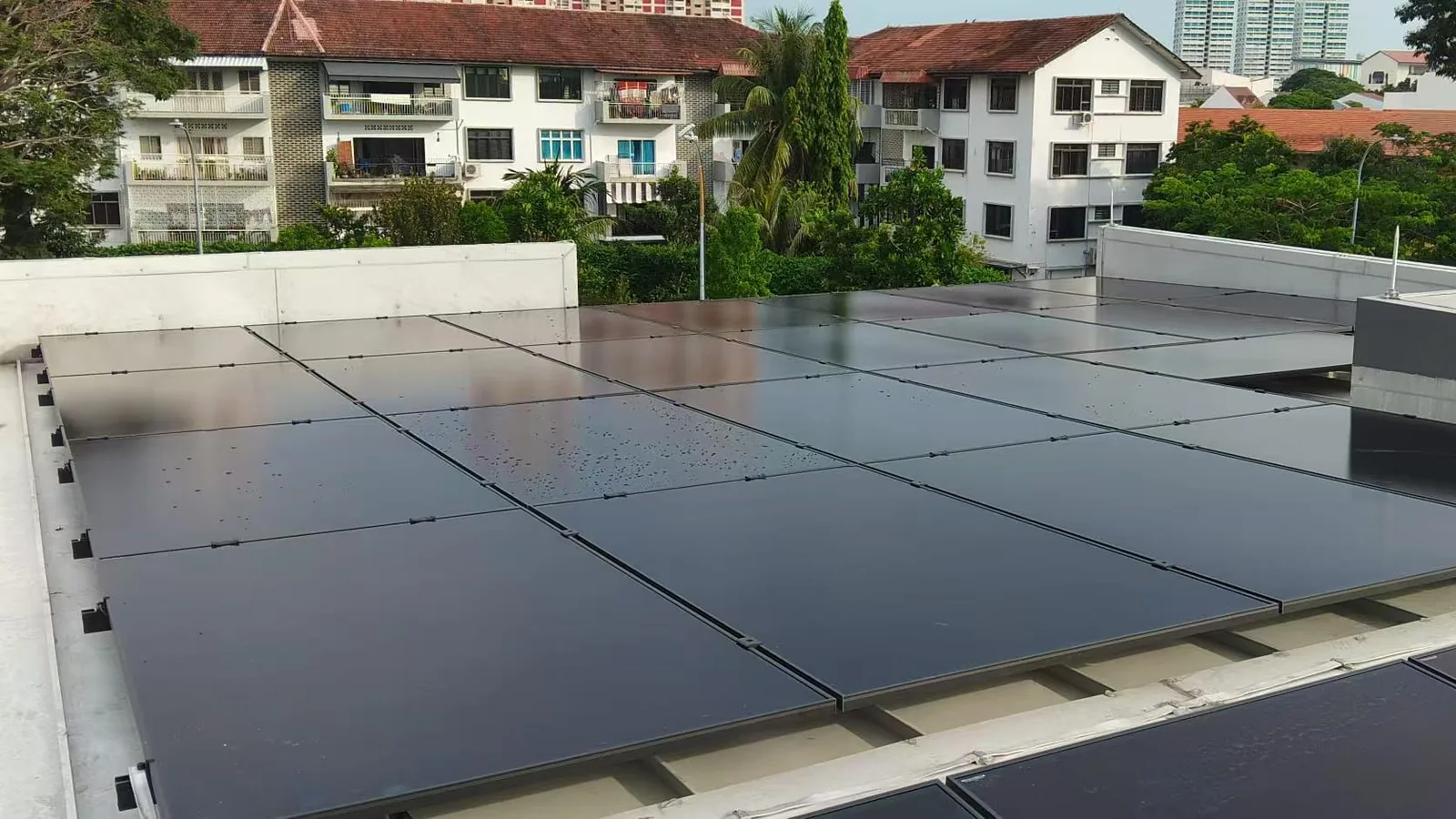
On a bungalow or GCB, roofs are large enough that the choice is usually which planes to leave clear rather than where to squeeze panels in. The trade-off is shading from mature trees, which is often not obvious from the ground. Rezeca’s Cluny Hill GCB case study covers an 89 kWp array on a large bungalow, and a separate 57 kWp system on a Good Class Bungalow in the Holland area shows the same approach on a different roof form.
What about the rest of the approvals?
Heritage status changes the URA question and nothing else. The rest is the process every landed home goes through: your system is designed, then a Licensed Electrical Worker handles the electrical submission and the turn-on with SP Group, including the meter arrangement that lets you be paid for surplus electricity. EMA approval is not something a homeowner applies for on a landed house. SCDF only enters the picture if you are adding battery storage above 20 kWh.
Typical timing is 1 to 2 weeks of installation on site, and 4 to 8 weeks from signed contract to switch-on, with the tail end dependent on SP Group’s connection timeline. A conserved property adds the roughly two-week Category 3 application to the front of that, which Rezeca plans for rather than promising a date nobody controls. The full sequence is in Rezeca’s solar approvals checklist.
Is it worth doing on an older or heritage house?
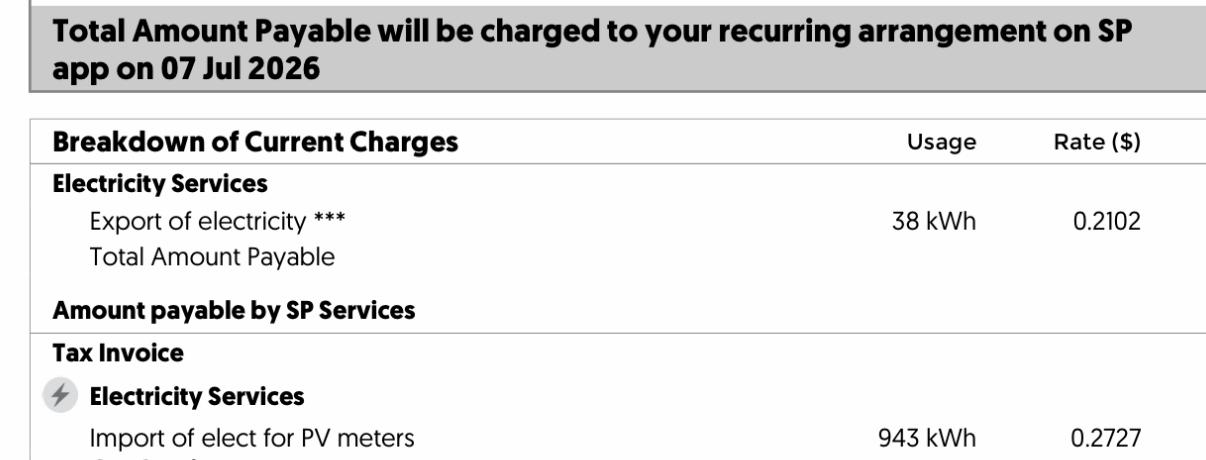
Usually, yes, and the economics are the same as for any landed home. Every unit you use yourself saves the full retail tariff, which is 31.16 cents per kWh including GST for the October to December 2026 quarter. Surplus you export earns less: roughly 22 cents under the Simplified Credit Treatment if you buy electricity from SP Group, and the half-hourly wholesale price if you are on a retailer plan, which has recently been lower still. A household that uses most of what it makes captures the higher number.
A Singapore roof generates in the region of 1,100 to 1,350 kWh per kWp per year, depending on shading, orientation and the weather that year. A 10 kWp system on a terrace makes roughly 11,000 to 13,500 kWh a year; a 40 kWp array on a large bungalow, roughly 44,000 to 54,000 kWh. Payback on a landed home system typically lands in the 3 to 6 year range, with larger, high-consumption systems at the shorter end, and quality panels carry 25 or 30-year warranties depending on brand. For the wider picture on sizing and cost, Rezeca’s complete guide for Singapore landed homes pulls it together.
Two caveats specific to older houses. Original roofs, particularly clay tile on pre-war terraces and bungalows, are sometimes near the end of their own life, and it makes little sense to put a 25-year array on a roof that needs replacing in five. And shading, from trees or taller neighbours, is the biggest single variable in what these roofs produce, which is why Rezeca surveys rather than quoting from a satellite image. The roof suitability self-assessment is a reasonable first read before anyone visits.
Where Rezeca fits
Rezeca Renewables has been installing solar in Singapore since 2009, with more than 1,500 installations and over 45 MWp to date, including 1,300+ residential landed homes, from inter-terraces to Good Class Bungalows. That means the team has worked through the URA question, the LEW and SP Group process, and the design conversation about how an array should look on a house people notice, many times over.
On heritage properties Rezeca would rather slow down at the start: confirm the conservation status on URA SPACE, read the applicable guidelines, walk the roof, and agree the visual approach with you before anything is ordered. See how residential solar installation works with Rezeca.
Frequently asked questions
Do I need URA approval to install solar on a landed house in Singapore?
Usually not. Solar panels added to an existing terrace, semi-detached house, bungalow or Good Class Bungalow are treated as an ancillary solar installation, which does not require URA planning permission unless one of three things applies: the property is in a Conservation Area or an area with urban design guidelines, the panels are raised more than 1 metre above roof level, or the space under the panels is enclosed or put to another use.
Can solar panels be installed on a conserved house in Singapore?
Yes. URA treats the installation of solar panels without any additional works on a conserved building as localised works for repair and maintenance, classified as Category 3 works. The application can be lodged by the owner or the contractor, is free of charge and takes about two weeks. If the project also involves reroofing, structural changes or facade alterations, it falls outside that lighter route and goes through the ordinary conservation permission process.
Can I put solar on a conserved terrace or shophouse, such as in Emerald Hill or Joo Chiat?
Generally yes, through the same Category 3 route. The main design constraint is visibility: arrays are usually placed on the rear roof pitch, kept flush and set back from the edges, so the street-facing roofscape is left as it is. The roof is smaller and shared along the party walls, so layout and cable routing need more care than on a detached house.
How do I find out if my house is conserved?
Search the address on URA SPACE or the URA Conservation Portal. They show whether the property is in a conservation area and whether the building itself is gazetted for conservation. Conserved landed homes include terraces in Blair Plain, Cairnhill and Emerald Hill, shophouses, terraces and bungalows in secondary settlements such as Joo Chiat, Geylang and Jalan Besar, and bungalows in areas such as Holland Park and Ridout Park, Nassim Road and White House Park, Chatsworth Park and Mountbatten Road.
Is a Good Class Bungalow the same as a conserved bungalow?
No. A Good Class Bungalow is a planning designation about plot size and density, and most GCBs are modern houses with no conservation status. A conserved bungalow is a building gazetted for conservation. Three bungalow conservation areas sit within or beside the GCB belt: Holland Park and Ridout Park with 27 conserved bungalows, Nassim Road and White House Park with 14, and Chatsworth Park, all gazetted on 29 November 1991.
Do I need approval to install solar on a cluster or strata landed house?
URA planning permission follows the same three triggers as any landed home, but the roof in a strata landed or cluster development is governed by the MCST’s by-laws, so you will usually need the management corporation’s consent before installation. Raise it early, since a council decision can take longer than the installation itself.
Will solar panels spoil the look of a heritage house?
They do not have to. The array can usually be kept off the street-facing roof plane, mounted flush to the roof with a clear margin at ridges and eaves, and specified in all-black modules that sit quietly against dark tile or a Black and White roof. Cabling is routed out of sight and the inverter is placed off the main elevation. Fixings can be chosen so the system is reversible, which matters both for conservation practice and for resale.
Thinking about solar on a conserved or landed house?
If you would like to know where your property stands, Rezeca can check the conservation status, look at the roof, and show you what a sympathetic array would actually look like on your house before you commit to anything. No obligation, and if the answer is that the trees or the roof make it not worth doing, Rezeca will say so.
Rezeca Renewables has installed solar for landed homes and businesses across Singapore since 2009, with over 1,500 installations and 45+ MWp to date, including 1,300+ residential landed homes.
Considering solar for your Singapore home?
Rezeca offers a free on-site assessment, no-obligation quotes, and full 25-year ROI projections based on your actual property. Own your system outright or finance it through UOB U-Solar, backed by 17 years of experience and 1,300+ landed-home installations.
Estimate your savingsWhatsApp:+65 9839 9044 | Email:enquiry@rezeca.com
All your solar questions, answered
Everything Singapore landed homeowners need to know about solar panel installation, costs, approvals, and returns.
Get Your Custom
Solar Plan
Prefer to chat? Tap the WhatsApp icon below to reach our team instantly.

Copyright © 2026 Rezeca Renewables.