Solar Panels for Singapore Landed Homes (2026 Guide)
Everything you need to know about installing solar on a terrace house, semi-detached, bungalow, or Good Class Bungalow in Singapore: costs, ROI, regulatory approvals, equipment, and how to choose an installer.
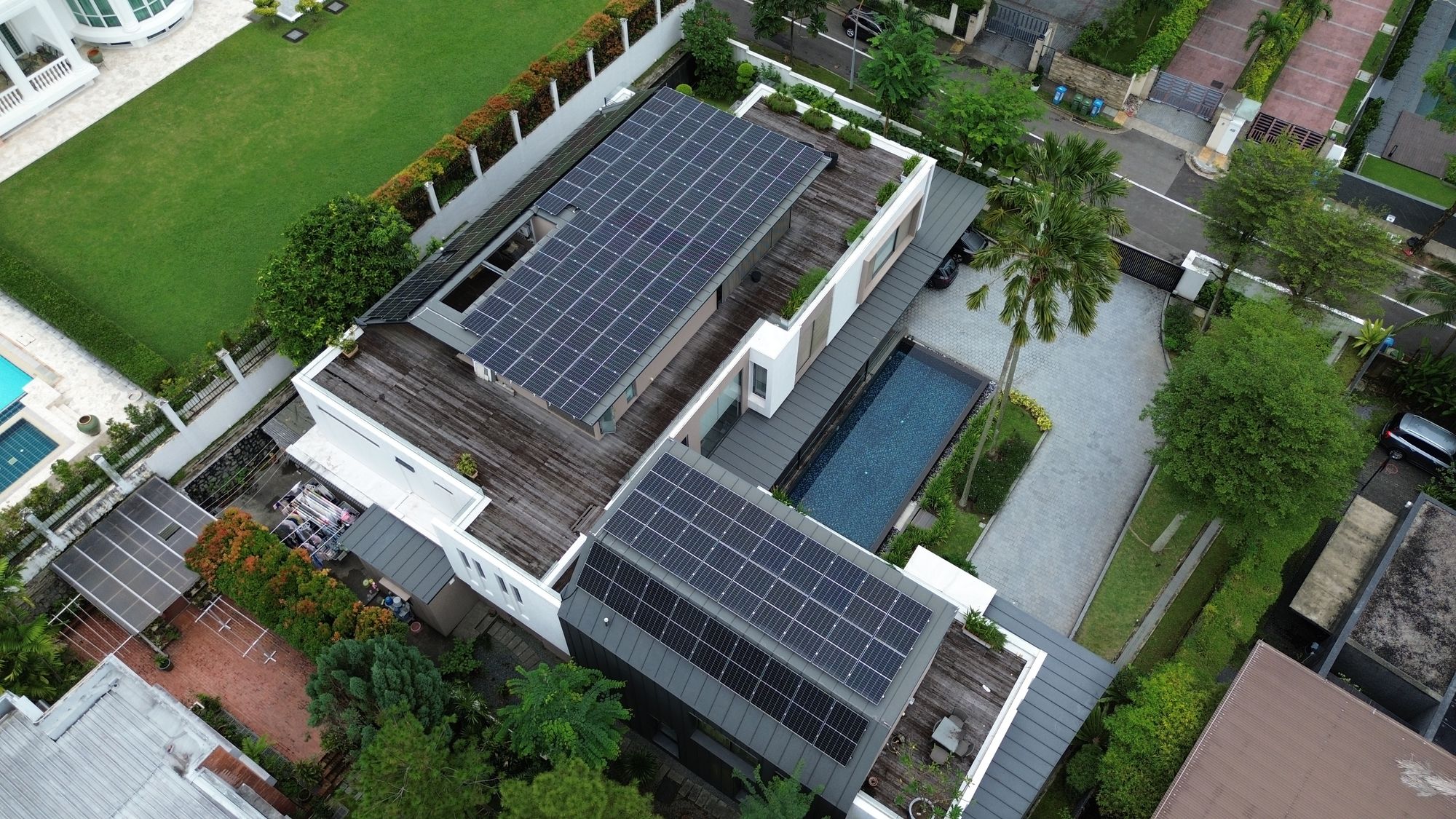
This guide is published by Rezeca Renewables, which has been installing solar on Singapore landed homes since 2009. Over 17 years we have completed more than 1,300 residential solar installations across every type of Singapore landed property. This page distills what we have learned into a practical reference for homeowners considering solar.
Why landed homes suit rooftop solar in Singapore
Singapore has roughly 73,000 landed properties — a small fraction of total housing stock, but representing the country's single largest concentration of usable, unshared rooftop area. Unlike HDB flats and condominiums, where solar deployment requires public-sector procurement or strata-wide MCST approval, landed homeowners control their own roofs and can decide independently to install solar.
Four factors make landed homes uniquely well-suited for solar in 2026:
- Dedicated, unshared roof space — typical landed roofs offer 40–200 square metres of usable area, enough for 8–40 kWp of solar capacity.
- Higher electricity consumption — landed homes consume 800–3,000+ kWh per month versus 300–600 for HDB flats. Higher consumption means more solar value.
- No MCST or strata approvals — installation requires only standard SP Group and LEW approvals, with no need for neighbour consent.
- Eligible for SP Group export credits — all landed homes qualify for the Simplified Credit Treatment (SCT) scheme, earning approximately S$0.22/kWh for surplus electricity exported to the grid (October to December 2026).
Singapore's equatorial location adds a fifth advantage: roughly 1,580 kWh/m² of annual solar irradiance, among the highest in Southeast Asia. A typical 15 kWp residential system generates approximately 16,500 kWh of electricity per year — equivalent to powering 4–5 average Singapore landed homes' lighting and aircon during daylight hours.
System sizes and savings by property type
Solar system sizing depends on three things: available roof area, household electricity consumption, and budget. Here are the typical ranges Rezeca installs across each Singapore landed property type:
| Property Type | Typical System | Annual Savings | Payback |
|---|---|---|---|
| Terrace house | 5–15 kWp | S$1,600–4,800 | 4–7 years |
| Semi-detached | 12–30 kWp | S$3,700–9,600 | 3–5 years |
| Bungalow | 20–40 kWp | S$6,400–13,000 | 3–5 years |
| Good Class Bungalow | 30–120 kWp | S$9,600–39,100 | 3–4 years |
Savings estimates based on Q4 2026 SP Group tariff rates (approximately S$0.31/kWh self-consumption, approximately S$0.22/kWh export) and typical household usage patterns. Actual figures depend on roof orientation, shading, and consumption profile.
How much does solar cost on a Singapore landed home in 2026?
Solar PV installations for Singapore landed homes typically cost approximately S$1,200 to S$2,000 per kWp installed in 2026, with the lowest per-kWp pricing available on larger systems where fixed costs (scaffolding, project management, regulatory fees) are spread across more capacity. Here is a typical breakdown:
| System Size | Property Fit | Typical Total Cost |
|---|---|---|
| 5–10 kWp | Small terrace | S$13,000–15,000 |
| 10–15 kWp | Standard terrace | S$15,000–21,000 |
| 15–25 kWp | Semi-detached | S$21,000–32,000 |
| 25–40 kWp | Bungalow | S$32,000–48,000 |
| 40–100+ kWp | Good Class Bungalow | S$48,000–130,000+ |
Five factors drive cost variance within these ranges:
- Roof type. Tile roofs (most common on Singapore landed homes) require more careful mounting than metal or RC roofs and cost slightly more per kWp installed.
- Panel brand. Tier-1 Chinese panels (Aiko, LONGi, Trina, Jinko) typically run 10–20% less than Singapore-made premium options like REC Alpha. All come with 25–30 year warranties.
- Inverter selection. String inverters (Huawei, Sungrow, SMA) are standard. Microinverters or DC optimisers add cost but improve performance on shaded roofs.
- Scaffolding requirements. Multi-storey homes typically require external scaffolding for the duration of installation, which adds S$2,000–8,000 depending on building height and access.
- Battery storage. Optional. Adds S$10,000–25,000 depending on capacity. Not always financially worthwhile in Singapore because of the favourable SP export rate.
Payback period and return on investment
Most Singapore landed-home customers achieve full payback in 3–6 years at 2026 tariff rates. High-consumption households with large roof areas and good orientation can break even in as little as 2.5–3 years. After payback, the system delivers essentially free electricity for the remaining 20–25+ years of its 30-year warranted lifespan.
Worked example: 20 kWp system on a semi-detached home
Consider a typical semi-detached home in Bukit Timah with monthly electricity bills of about S$685 (consumption ~2,200 kWh per month). Rezeca installs a 20 kWp system using Aiko panels and a Sungrow inverter at a total cost of approximately S$24,000.
- Annual solar generation: ~22,000 kWh
- Self-consumption (60%): 13,200 kWh × approximately S$0.31/kWh ≈ S$4,090 saved on bills
- Export to grid (40%): 8,800 kWh × approximately S$0.22/kWh ≈ S$1,940 in export credits
- Annual financial benefit: ~S$6,000
- Payback period: approximately S$24,000 ÷ S$6,000 ≈ 4 years
- 25-year net benefit: ~S$150,000 (assuming flat tariffs; higher with tariff inflation)
Note that real payback is usually faster than this conservative example suggests. Singapore's electricity tariffs have risen consistently over the past decade, and every tariff increase shortens the payback period further.
The regulatory approval process for solar in Singapore
Singapore has more regulatory touchpoints for residential solar than most countries, but the process is well-defined and a competent installer manages every submission on the homeowner's behalf. Here is what is involved:
SP Group
Every grid-connected solar system in Singapore requires approval from SP Group for grid connection and installation of a bi-directional smart meter. The meter records both electricity imported from the grid and electricity exported back to the grid. SP Group approval typically takes 3–5 weeks from application submission.
Energy Market Authority (EMA)
Residential homeowners do not need EMA approval or licensing to install solar on a landed home. EMA licensing applies to larger non-residential and commercial systems — typically where electrical demand exceeds 45 kVA — not to standard residential rooftop installations. For a landed home, the grid-related paperwork is handled through SP Group's turnkey application, submitted on your behalf by the Licensed Electrical Worker (LEW) overseeing the installation. If you later add solar to a larger commercial building, EMA requirements may apply and a competent EPC will advise on them.
Building and Construction Authority (BCA)
BCA structural assessment may be required for older buildings (typically pre-1990 construction) or for systems where the additional roof load is significant. Most modern Singapore landed homes do not require BCA submission. Where it is needed, the assessment is typically completed by a Professional Engineer.
Urban Redevelopment Authority (URA)
URA approval applies only to conservation properties and protected buildings — generally not relevant to most landed homes. Where applicable, URA reviews whether the solar installation affects the building's heritage character.
Ministry of Manpower (MOM) — work-at-height safety
The installer must comply with WSH Act requirements including proper scaffolding, fall protection, and trained personnel for multi-storey buildings. This is the installer's responsibility — homeowners do not file with MOM directly.
Licensed Electrical Worker (LEW)
All electrical work on a Singapore solar installation must be carried out under a Licensed Electrical Worker. The LEW signs off on the system's electrical design and compliance, and is the technical accountable party for the installation. Always confirm which LEW will sign off on your specific system before contract signing.
Roof types and their implications for solar
Singapore landed homes come with three main roof types. Each requires different mounting approaches:
Tile roof
Most common on traditional landed homes. Solar panels are mounted on rails secured to roof rafters via specialised tile hooks. Proper installation requires careful waterproofing at each mounting point and meticulous handling of fragile clay or concrete tiles. Tile roofs can support solar but require more skilled installation than other roof types.
Metal roof
Common on newer landed homes and accessory structures. Solar panels are mounted directly to the metal sheeting using clamps that do not penetrate the roof surface, eliminating leak risk. Metal roofs are generally the easiest and most cost-effective for solar installation.
Reinforced concrete (RC) roof / flat roof
Found on modern bungalows and contemporary architectural designs. Panels are mounted on ballasted frames or chemically anchored to the concrete. Flat roofs allow optimal panel tilt regardless of building orientation, often delivering higher per-kWp generation than fixed-tilt installations.
For all roof types, the key question is structural load capacity. A typical solar installation adds 12–20 kg/m² of dead load — well within design limits for properly-constructed Singapore landed homes, but worth confirming for older or unusually-designed buildings.
Equipment: panels, inverters, and what to look for
Solar panels
Use only Tier-1 panel brands with strong manufacturer warranties. As of 2026, the leading options in Singapore are:
- Aiko (ABC technology, 25-year product warranty, 30-year performance warranty) — Rezeca's current standard, strong value per watt for landed home installations.
- LONGi (Hi-MO and EcoLife series, 25-year product warranty) — one of the world's largest manufacturers, strong reliability track record.
- REC Solar (Alpha series, 25-year product warranty) — Singapore-manufactured premium option using HJT cells.
- Trina Solar (Vertex series, 25-year product warranty) — well-established Chinese Tier-1 with strong Asia-Pacific service network.
- Jinko Solar (Tiger Neo series, 25-year product warranty) — one of the largest manufacturers by volume, competitive pricing.
Inverters
The inverter converts DC electricity from the panels to AC electricity usable in the home. The five main options for Singapore residential installations:
- Huawei (SUN2000 series) — feature-rich, strong app and monitoring, market-leading EMMA system for whole-home energy management.
- Sungrow (SG-CX series) — robust, competitive pricing, particularly strong for commercial-scale systems.
- SMA (Sunny Boy / Tripower series) — German-engineered, premium positioning, 10-year standard warranty.
- Fronius (Symo / Primo series) — Austrian-made premium inverter with industry-leading software.
- SolarEdge — uses DC power optimisers per panel, excellent for shaded or complex roofs but at higher cost.
Mounting systems
Rails, clamps, and roof attachments must match roof type and meet wind-load standards. In Singapore, mounting hardware should be aluminium or stainless steel to resist humid tropical conditions. Galvanised steel will rust within years and is not appropriate for residential installations.
Renewable Energy Certificates (RECs): the optional revenue stream
Every megawatt-hour (1,000 kWh) of solar electricity generated earns one tradeable I-REC certificate. RECs are bought by corporations seeking to meet sustainability commitments — and they represent an additional revenue stream on top of the electricity savings.
A 15 kWp residential system generating 16,500 kWh annually produces approximately 16–17 I-RECs per year. At current market prices (S$2–5 per certificate), that translates to S$30–85 in additional annual income. Over 25 years, REC revenue compounds to S$1,000–2,500 per typical residential system.
REC registration requires technical paperwork: I-REC Standard enrolment, monthly generation tracking, annual certificate submission. Rezeca offers full REC management at no additional cost on most installations, handling all registration and submission on the homeowner's behalf with the proceeds either credited back or reinvested in the system.
How to choose a solar installer in Singapore
Choosing the right installer matters more than choosing the right panel. The hardware is largely commoditised; the workmanship, project management, and decades-long support relationship are not. Here is what to evaluate:
Track record
- How many years has the company been installing solar in Singapore specifically?
- How many landed-home projects have they completed (ask for a specific number, not just "hundreds")?
- Can they show you reference installations of similar size and roof type to yours?
Team composition
- Is the installation team in-house, or do they subcontract?
- Which Licensed Electrical Worker will sign off on your system?
- How many of their installers hold WSH (Workplace Safety and Health) certifications?
Equipment and warranties
- What panel and inverter brands do they offer? Are they Tier-1?
- What is the workmanship warranty (not just panel warranty)?
- Who honours the warranty if the installer goes out of business?
Process and transparency
- Will they handle SP Group, BCA, and URA submissions on your behalf?
- Do they provide an itemised quote with no hidden costs?
- Do they include a 25–30 year ROI projection based on your actual roof and consumption?
Certifications
- BCA registration (confirms legal capacity to install in Singapore)
- BizSAFE Star or higher (workplace safety standard)
- ISO 45001 or equivalent occupational health and safety certification
- Manufacturer-certified installer status with the panel brand they use
What the installation process actually looks like
End-to-end timeline from first enquiry to commissioned, generating system is typically 8–12 weeks. Here is the breakdown:
Week 1–2: Site assessment and design
On-site visit by a solar engineer to measure roof, assess orientation and shading, check electrical infrastructure, and capture the data needed for system design. Followed by a detailed proposal including system layout, equipment specification, pricing, and full 30-year ROI projection.
Week 2–5: Regulatory approvals
SP Group turnkey application submitted by the Licensed Electrical Worker. SP Group meter upgrade requested. BCA and URA submissions if required by property type. This is the slowest phase — typically 3–5 weeks of pure waiting time.
Week 5–8: Physical installation
Scaffolding erection (for multi-storey homes), panel mounting, electrical wiring, inverter installation. Active installation work typically takes 1–3 days on site. Singapore's frequent rain can occasionally extend timelines by a day or two.
Week 8–10: Commissioning and SP meter change
System electrical testing, inverter commissioning, performance verification. SP Group installs the new bi-directional meter — this is the gateway moment when the system goes live and starts both reducing your bill and earning export credits.
Ongoing: monitoring and maintenance
After commissioning, the system is connected to a monitoring app showing real-time generation. Recommended maintenance includes panel cleaning every 6–12 months and an annual system inspection. Plan for one inverter replacement, typically somewhere between year 5 and year 15; panels last 25–30+ years.
Common misconceptions about solar in Singapore
"Singapore is too rainy for solar"
Singapore actually has one of the highest annual solar irradiance levels in Southeast Asia (~1,580 kWh/m²/year). Cloud cover does reduce output on overcast days, but panels still generate 10–25% of peak power even in heavy overcast. Real-world annual yield in Singapore averages around 1,100 kWh per kWp installed.
"Panels will damage my roof or cause leaks"
Properly-installed solar mounting uses techniques designed to preserve roof integrity. Tile roofs use specialised hooks that do not crack tiles. Metal roofs use clamp-on attachments with no penetration. RC roofs use ballasted or chemically-anchored frames. Leaks are almost always the result of poor installation, not solar panels themselves — which is why installer quality matters.
"The payback is too long to be worth it"
At 2026 tariff rates, most Singapore landed-home customers achieve payback in 3–6 years. The system then continues generating for 20+ more years of essentially free electricity. Total 25-year financial benefit on a typical installation is typically 3–5 times the initial investment.
"I should wait for technology to improve"
Panel efficiency has improved roughly 0.5% per year over the past decade — meaningful at industry scale but minor at the individual home level. Meanwhile, every year of delay is a year of paying full SP tariff rates for electricity that solar could have offset. The economics favour acting sooner.
Frequently asked questions
How much do solar panels cost for a Singapore landed home in 2026?
Solar panel installation in Singapore costs approximately S$1,200 to S$2,000 per kWp installed in 2026. A typical landed home system totals S$15,000 to S$80,000 depending on system size, roof type, and equipment selected, with the largest Good Class Bungalow systems running higher. Rezeca provides itemised quotes with full 30-year ROI projections at no cost.
How long is the payback period for solar panels on a Singapore landed home?
Most Singapore landed-home customers achieve full payback in 3–6 years at Q4 2026 SP Group tariff rates (approximately S$0.31/kWh retail, approximately S$0.22/kWh export). High daytime electricity users break even in as little as 3–4 years. After payback, the system generates essentially free electricity for the remaining 20–25+ years of its 30-year warranty.
Can I sell excess solar electricity back to SP Group?
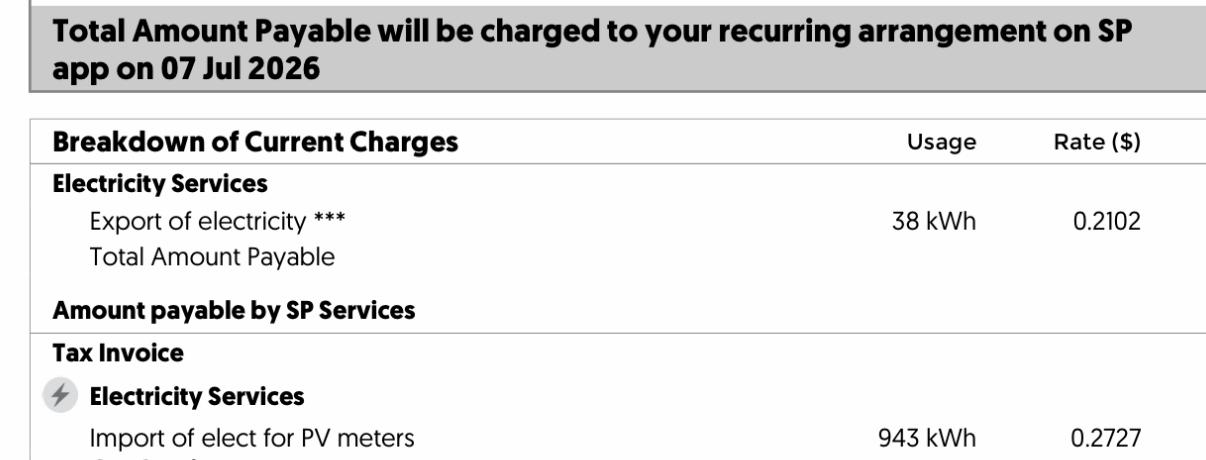
Yes. Singapore homeowners with grid-connected solar export surplus electricity to SP Group at approximately S$0.22/kWh (October to December 2026) under the Simplified Credit Treatment (SCT) scheme. A bi-directional smart meter installed during commissioning tracks both import and export automatically. Credits appear directly on the monthly SP Group electricity bill.
Will solar panels work on cloudy or rainy days?
Yes. Solar panels generate electricity even in diffuse light conditions during cloudy or rainy weather. Singapore's near-equatorial position means consistent solar irradiance year-round with an average of 3–4 peak sun hours daily, even during the monsoon season. While output is reduced on overcast days (typically 10–25% of peak), panels continue producing meaningfully. Real-world annual yield in Singapore averages 1,100 kWh per kWp installed.
What approvals are needed to install solar panels on a Singapore landed home?
Grid-connected solar in Singapore requires approval from SP Group (grid connection and bi-directional meter) and a Licensed Electrical Worker (LEW), plus potentially BCA (structural assessment for older buildings) and URA (only for conservation properties). Residential homes do not need EMA licensing — that applies to larger non-residential systems. Rezeca handles every submission on the homeowner's behalf. Typical approval timeline is 3–5 weeks.
How long does the installation actually take?
End-to-end timeline from first enquiry to commissioned, generating system is 8–12 weeks. Physical on-site installation is 1–3 days. The majority of the timeline is regulatory approval lead time, which an experienced installer cannot speed up but does manage on the homeowner's behalf.
Are solar panels safe on a tile roof?
Yes, with proper installation. Solar panels are mounted on rails secured via specialised tile hooks that do not penetrate or crack the tiles. Proper waterproofing is applied at each attachment point. Leaks are almost always the result of poor installation, not solar panels themselves. Always verify that your installer has specific experience with tile roofs in Singapore — they are the most common but require the most careful mounting technique.
What size solar system does my home need?
System size depends on three factors: available roof area, household electricity consumption, and budget. Typical ranges by property type: terrace house 5–15 kWp, semi-detached 12–30 kWp, bungalow 20–40 kWp, GCB 30–120 kWp. A solar engineer assesses your specific roof during the site visit using satellite imagery and on-site measurement to determine actual capacity.
How long do solar panels last?
Modern Tier-1 solar panels carry 25-year product warranties and 30-year performance warranties. Real-world panel lifespans typically exceed 30 years with annual output degradation of only 0.4–0.5% per year. Inverters have a shorter working life. Warranty is 5 or 10 years depending on model, but that is not service life: most units run past warranty and are replaced once during the panel system's life, typically between year 5 and year 15, at a cost of roughly S$2,000–S$8,000 depending on capacity.
What maintenance do solar panels require?
Minimal. Solar systems have no moving parts. Recommended maintenance: panel cleaning every 6–12 months (Singapore dust and bird droppings can reduce output by 5–15% if left), annual system inspection covering electrical connections and inverter diagnostics, and one inverter replacement over the system's life. Rezeca provides 2 years of complimentary maintenance with every new installation.
Does solar panel installation increase property value?
Solar installations are increasingly factored into landed property purchase decisions in Singapore, particularly in the premium segment. Buyers value lower running costs and sustainability features. While there is no specific Singapore study quantifying the resale premium, comparable mature solar markets (Australia, Germany, California) show 3–5% property value uplift for homes with paid-off solar systems.
Should I add battery storage to my solar system?
Usually not, for most Singapore landed homes in 2026. Battery storage adds S$10,000–25,000 to system cost. Singapore's favourable SP export rate (approximately S$0.22/kWh) and reliable grid mean that exporting surplus electricity is almost as financially beneficial as storing it. Batteries make sense in three specific cases: properties with frequent grid outages, properties with electric vehicles charged overnight, or households planning for full grid independence over the long term.
Does Rezeca install solar on HDB flats or condominiums?
No. Rezeca specialises in landed properties (terrace, semi-detached, bungalow, Good Class Bungalow), commercial buildings, schools, and factories. HDB solar is typically deployed through the public-sector SolarNova programme administered by Sembcorp and EDPR Sunseap. Condominium installations require strata-wide MCST approval and are not part of Rezeca's service offering.
What is the difference between RECs and SP Group export credits?
Two separate revenue streams that can both be earned simultaneously. Export credits (under the SCT scheme) are payments from SP Group at approximately S$0.22/kWh for surplus electricity sent to the grid — direct bill offset. RECs (Renewable Energy Certificates) are tradeable environmental credits, one per MWh of solar generated regardless of whether you consumed or exported that electricity, sold to corporations meeting sustainability commitments at S$2–5 per certificate. Rezeca manages REC registration and submission on the homeowner's behalf.
The bottom line
Solar on a Singapore landed home is one of the most financially defensible decisions a homeowner can make in 2026. Payback periods of 3–6 years, 30-year warranted equipment lifespans, attractive export rates, and rising grid tariffs combine to make the math compelling for nearly every landed property in Singapore.
The choice that matters most is not whether to install solar, but who installs it. The system will outlast the warranty paperwork. The installer's ability to support that system through year 25 — to honour workmanship guarantees, manage RECs, replace inverters, troubleshoot performance issues — matters more than saving S$1,000 on the upfront quote.
Rezeca Renewables has been installing solar in Singapore since 2009 and has completed 1,300+ landed-home solar systems, part of 1,500+ projects totalling 45+ MWp. We would be glad to assess your property and prepare a detailed, no-obligation proposal.
Solar in a new light.
Considering solar for your Singapore home?
Rezeca offers a free on-site assessment, no-obligation quotes, and full 25-year ROI projections based on your actual property. Own your system outright or finance it through UOB U-Solar, backed by 17 years of experience and 1,300+ landed-home installations.
Estimate your savingsWhatsApp:+65 9839 9044 | Email:enquiry@rezeca.com

All your solar questions, answered
Everything Singapore landed homeowners need to know about solar panel installation, costs, approvals, and returns.
Get Your Custom
Solar Plan
Prefer to chat? Tap the WhatsApp icon below to reach our team instantly.

Copyright © 2026 Rezeca Renewables.