Single-Phase vs Three-Phase: Can Your Landed Home Take Solar? (Singapore, 2026)
Both single-phase and three-phase landed homes can go solar. The real difference is how big you can go, and whether a phase upgrade is worth it. Here's the honest guide.
The quick answer: Both single-phase and three-phase landed homes can install solar, and single-phase supports more than many people assume. A single-phase supply can typically run up to around a 10 kW inverter, which with normal panel oversizing (about a 1.3 DC-to-AC ratio) means a system of roughly 13 kWp. Where your main breaker is larger, for example 100A, there can be room for a bigger inverter or even two. A three-phase supply lifts the ceiling much higher: a standard 63A three-phase breaker can support up to around a 40 kW inverter, so on three-phase your roof size, not the supply, is usually what limits the system. Your installer’s Licensed Electrical Worker (LEW) confirms exactly what your main breaker, switchboard and SP Group connection can support before anything is finalised.
First, what is single-phase versus three-phase power?
Every home in Singapore is connected to the grid through either a single-phase or a three-phase supply. The difference is simply how many “live” lines bring power into your home.
A single-phase supply delivers electricity on one live line at around 230 volts. It’s common in smaller or older landed homes and is perfectly adequate for ordinary household loads, and for a sizeable solar system too.
A three-phase supply brings power on three live lines (about 400 volts across them) and can carry considerably more power at once. Larger and newer landed homes often have three-phase because they run heavier loads: multiple air-conditioning zones, a pool pump, an electric-vehicle charger, a lift, and so on.
Think of it as the width of the pipe bringing electricity in and out of your home. Single-phase is a narrower pipe, three-phase a wider one. But as we’ll see, single-phase is wider than most people expect, and the size of your solar system usually comes down to your main breaker and your roof rather than the phase alone.
How do I know which one my home has?
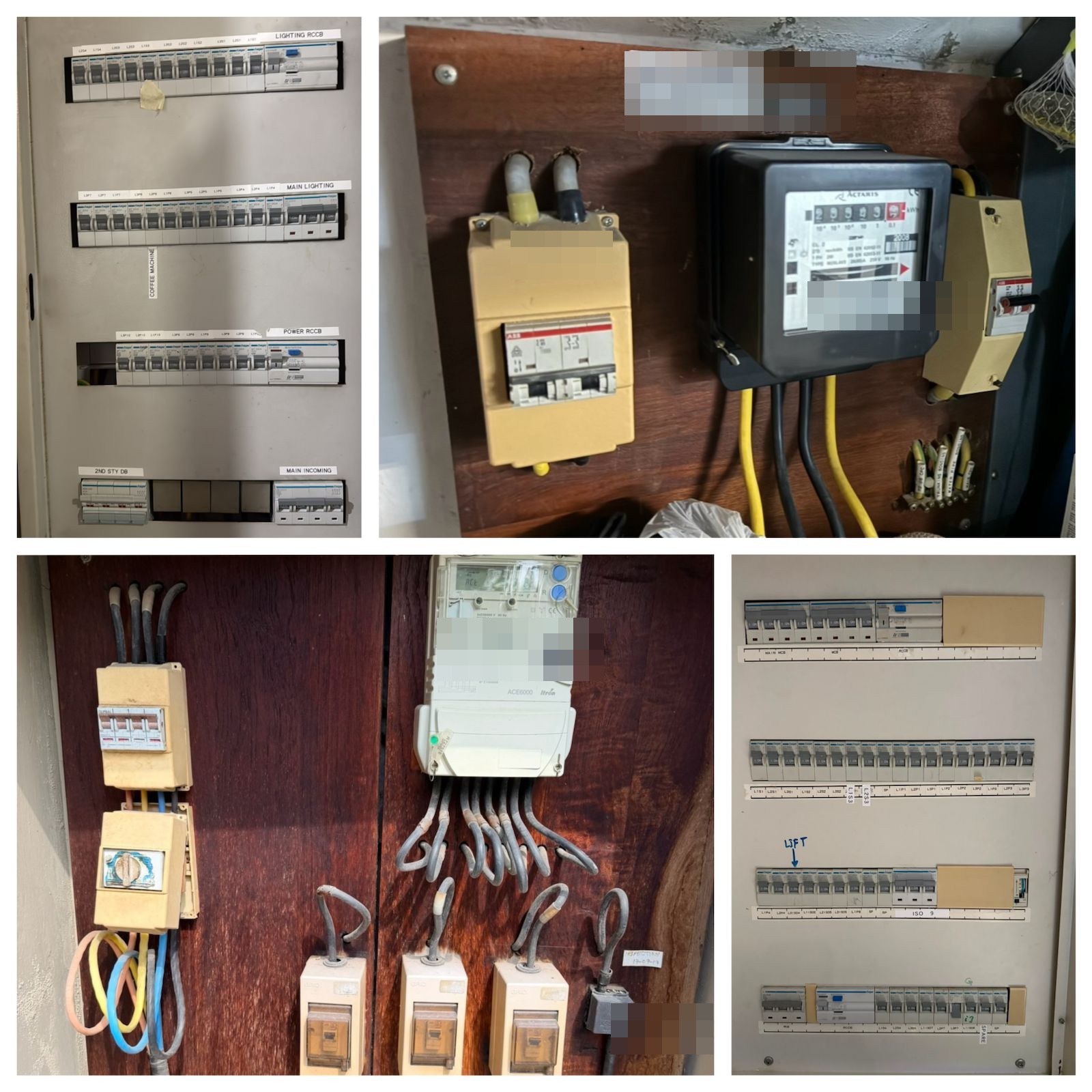
The most reliable way is to look at your electrical board, not your bill:
- Look at your main switch and distribution board (DB). A single-phase supply has a single main switch and one live line; a three-phase board has a larger three-pole main switch and three live lines, often labelled Red, Yellow, Blue, or L1, L2, L3.
- Check the main breaker. Its rating (for example 63A or 100A) and whether it is single-pole or three-pole tells an electrician your supply type and how much it can carry.
- Ask an electrician or your installer. During a site assessment, the LEW confirms your supply type and breaker rating in a minute. It’s one of the first things a competent installer checks.
If you’re not sure, don’t worry about pinning it down yourself. Establishing your supply type and breaker rating is part of the free site assessment, and it directly shapes the system we’d recommend. We’ve done this across more than 1,500 installations since 2009, so it’s routine.
Can a single-phase home still install solar?
Yes, and usually a larger system than people expect. Single-phase is not the tight limit it’s often made out to be.
A single-phase supply can typically support up to around a 10 kW inverter. Because panels are normally oversized relative to the inverter (a DC-to-AC ratio of about 1.3 is standard practice), that translates to a solar array of roughly 13 kWp, which is plenty for many landed roofs. What really sets the ceiling is your main breaker rating, not the fact of being single-phase. On a larger single-phase supply, such as a 100A main breaker, there can be room for a bigger inverter or even two inverters (for example a pair of 6 kW or 8 kW units), pushing the system size higher still. Your LEW confirms what your specific breaker and switchboard allow.
Whatever the size, any surplus your panels produce is exported to the grid under the Simplified Credit Treatment (SCT) scheme and credited on your SP Group bill at around 26 cents per kWh. The goal is to match the system honestly to what your breaker, switchboard and roof allow.
Why does three-phase let you go bigger?
On a three-phase home, the incoming supply is rarely the constraint. What limits the system is your roof size and breaker rating, not the phase itself.
A standard 63A three-phase breaker can support up to around a 40 kW inverter, which is far more than almost any landed roof can physically hold. So on a three-phase home, the roof, not the electrics, is usually what decides how large a system you can fit. There’s a second benefit too: a three-phase inverter spreads its output evenly across the three lines, roughly a third on each, which keeps the current on any one line low and the voltage rise on export small. That’s one of the technical checks SP Group and your LEW care about.
In practice, most larger landed homes install 12 to 20 kWp, with Good Class Bungalows going higher, sized to the roof and to how much electricity the home uses. Our guide to how many solar panels a landed home actually needs walks through sizing in detail.
Should I upgrade from single-phase to three-phase for solar?
Often you won’t need to. Since a single-phase supply already supports up to around a 10 kW inverter (roughly a 13 kWp system, or more with a larger breaker), many homes fit all the solar they need without touching their supply. You’d only look at a three-phase upgrade if you want a system bigger than your single-phase breaker allows and your roof and usage justify it.
It’s worth knowing what an upgrade actually involves, because it’s a real piece of work. Beyond the SP Group application and changes to your main switchboard, it usually means replacing the supply cable from your meter all the way to the supply box on the road, coordinated by a Licensed Electrical Worker. That cable run is a big part of the cost, so the price varies significantly with the distance between your house and that road-side box: a home close to it is far cheaper to upgrade than one set well back from the road. It also adds a few weeks of lead time.
Because the cost swings so much from home to home, a phase upgrade isn’t a decision to rush. The honest approach is to weigh the extra solar you’d gain against what the upgrade would cost for your specific address, which is exactly the kind of trade-off we work through during a site assessment rather than assume. We’d only suggest it where the numbers clearly justify it.
So how big a system does my home actually need?
Phase type and breaker set the ceiling, but your roof and your electricity usage set the right size within it. A home that uses a lot of power in the daytime benefits from a larger system; one that’s empty from nine to five sees more of its solar exported at the lower SCT rate rather than used at the full retail tariff of 34.78 cents per kWh (including GST) for the July to September 2026 quarter.
That interaction, supply, roof, and usage together, is why there’s no single “right” number. It’s also why a proper assessment beats an off-the-shelf quote. Our complete 2026 guide to solar for landed homes and our cost guide put the numbers in context.
Single-phase vs three-phase at a glance
| Single-phase | Three-phase | |
|---|---|---|
| Live lines | One (~230 V) | Three (~400 V) |
| Typical inverter ceiling | Up to ~10 kW (more with a larger main breaker) | Up to ~40 kW on a standard 63A breaker |
| Typical system size | Around 13 kWp, higher on a 100A supply | Usually limited by the roof; 12 to 20 kWp and beyond |
| What sets the limit | Main breaker rating and roof | Roof size and breaker rating, not the incoming supply |
| Upgrade for a bigger system? | Possible; cost depends heavily on cable distance to the road-side box | Not needed, already suited to large systems |
Exact limits depend on your main breaker, switchboard and SP Group’s approval. Your LEW confirms what your home can take during the site assessment.
What your installer and LEW actually check
Before any system size is confirmed, a thorough installer’s Licensed Electrical Worker looks at:
- your supply type (single or three-phase) and your main breaker rating,
- the main switch, distribution board, and cable route, to see whether they can carry the proposed inverter,
- the expected voltage rise on export, and
- SP Group’s connection requirements for the size you want.
That assessment is what turns “can my home take solar” into a specific, honest recommendation. It’s also handled for you: the LEW files the SP Group connection and registers your system for SCT sell-back, as we explain in our guide to solar approvals in Singapore.
Frequently asked questions
Can a single-phase house install solar panels in Singapore?
Yes, and often a substantial system. A single-phase supply can typically run up to around a 10 kW inverter, which with normal panel oversizing (about a 1.3 DC-to-AC ratio) means roughly a 13 kWp system. On a larger main breaker, such as 100A, there can be room for a bigger or even a second inverter. Your LEW confirms what your breaker and switchboard allow.
What’s the difference between single-phase and three-phase power?
Single-phase brings electricity on one live line at about 230 volts; three-phase uses three live lines at about 400 volts and carries much more power. Larger and newer landed homes often have three-phase because they run heavier loads. For solar, three-phase allows a bigger system and spreads the export evenly across the three lines.
How do I know if my home is single-phase or three-phase?
Look at your main switch and distribution board: a three-phase board has a three-pole main switch and three live lines (often labelled L1, L2, L3), while single-phase has one. Your electricity bill doesn’t show this, so the clearest way is to check the board or ask an electrician or installer, who confirms it during a site assessment.
Do I need to upgrade to three-phase to install solar?
Usually not. A single-phase supply already supports up to around a 10 kW inverter (roughly 13 kWp, or more with a larger breaker), which suits many homes. You’d consider a three-phase upgrade only for a bigger system. An upgrade involves an SP Group application and replacing the cable from your meter to the road-side supply box, so the cost depends a lot on how far your house sits from that box.
How big a solar system can a three-phase landed home have?
On three-phase the roof is usually the limit, not the supply: a standard 63A three-phase breaker supports up to around a 40 kW inverter, more than most landed roofs can hold. Typical larger landed systems are 12 to 20 kWp, with GCBs higher.
Not sure which supply your home has?
That’s exactly what a free site assessment settles, along with what your roof can hold and what you’d realistically save. We’ll tell you honestly whether your single-phase supply is already enough or whether a three-phase upgrade would actually pay for itself, with no pressure either way. Book a free site assessment and we’ll map it out for your address.
Rezeca Renewables has installed solar for landed homes and businesses across Singapore since 2009, with over 1,500 installations and 45+ MWp to date, including 1,300+ residential landed homes.
Considering solar for your Singapore home?
Rezeca offers a free on-site assessment, no-obligation quotes, and full 25-year ROI projections based on your actual property. Own your system outright or finance it through UOB U-Solar, backed by 17 years of experience and 1,300+ landed-home installations.
Estimate your savingsWhatsApp:+65 9839 9044 | Email:enquiry@rezeca.com
Get Your Custom
Solar Plan
Prefer to chat? Tap the WhatsApp icon below to reach our team instantly.

Copyright © 2026 Rezeca Renewables.