Singapore Electricity Tariff October 2026: Current SP Rate, History Since 2022 and What It Means for Solar
The current SP Group tariff (31.16 cents incl GST from 1 October 2026), every quarter since 2022 with GST, the solar export rate and what it means for solar savings. Updated every quarter.

The quick answer: From 1 October to 31 December 2026, SP Group's regulated household electricity tariff is 31.16 cents per kWh including GST (28.59 cents before GST). That is 10.4% lower than July to September 2026, the highest quarter since at least 2022, but still about 5% higher than April to June 2026 and above every quarter of 2025. SP Group has warned it may rise again from January 2027 if fuel prices stay high. For solar, each unit your panels produce and you use now saves about S$0.31, and surplus you export earns about S$0.22 under the Simplified Credit Treatment (SCT). A typical landed-home system still pays back within the 3 to 6 year range. This page is updated every quarter when SP Group announces the new rate.
What is the electricity tariff in Singapore right now?
| Regulated household tariff, before GST | 28.59 cents per kWh |
| GST at 9% | +2.57 cents per kWh |
| What you pay | 31.16 cents per kWh |
| Change vs July to September 2026 | −10.4% (−3.32 cents before GST) |
| Change vs April to June 2026 | +4.8% |
| Change vs October to December 2025 | +3.8% |
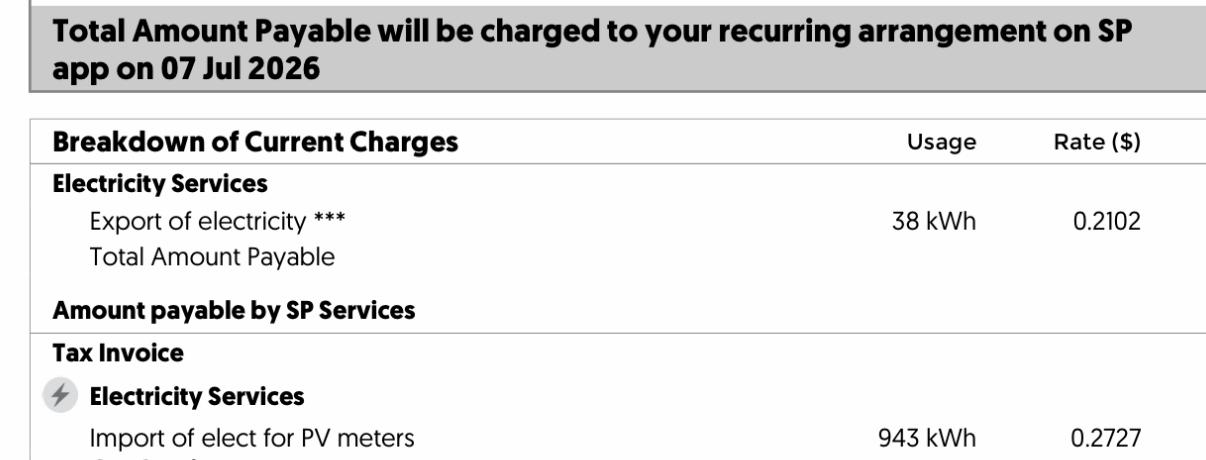
| Solar export credit under SCT | About 22 cents per kWh (tariff before GST less the 6.25-cent grid charge; no GST on the credit) |
| Valid | 1 October to 31 December 2026. The next revision is normally announced in the last days of December. |
Source: SP Group tariff revision for 1 October to 31 December 2026, announced 30 September 2026.
SP Group reviews the tariff every quarter under guidelines set by the Energy Market Authority. The energy cost part of each quarter's tariff is set from natural gas prices over the first two and a half months of the quarter before, so the October cut reflects the lower gas prices of July to mid-September. SP Group also flagged that global fuel prices have risen since September because of tensions in the Middle East, and that if this persists, tariffs are expected to increase for the following quarter.
Singapore electricity tariff history, 2022 to 2026
| Quarter | Before GST (cents/kWh) | GST | What you pay (cents/kWh) |
|---|---|---|---|
| Jan to Mar 2022 | 25.44 | 7% | 27.22 |
| Apr to Jun 2022 | 27.94 | 7% | 29.90 |
| Jul to Sep 2022 | 30.17 | 7% | 32.28 |
| Oct to Dec 2022 | 29.74 | 7% | 31.82 |
| Jan to Mar 2023 | 28.95 | 8% | 31.27 |
| Apr to Jun 2023 | 27.43 | 8% | 29.62 |
| Jul to Sep 2023 | 27.74 | 8% | 29.96 |
| Oct to Dec 2023 | 28.70 | 8% | 31.00 |
| Jan to Mar 2024 | 29.89 | 9% | 32.58 |
| Apr to Jun 2024 | 29.79 | 9% | 32.47 |
| Jul to Sep 2024 | 29.88 | 9% | 32.57 |
| Oct to Dec 2024 | 29.10 | 9% | 31.72 |
| Jan to Mar 2025 | 28.12 | 9% | 30.65 |
| Apr to Jun 2025 | 28.12 | 9% | 30.65 |
| Jul to Sep 2025 | 27.47 | 9% | 29.94 |
| Oct to Dec 2025 | 27.55 | 9% | 30.03 |
| Jan to Mar 2026 | 26.71 | 9% | 29.11 |
| Apr to Jun 2026 | 27.27 | 9% | 29.72 |
| Jul to Sep 2026 | 31.91 | 9% | 34.78 |
| Oct to Dec 2026 | 28.59 | 9% | 31.16 |
Regulated household (domestic, low-tension) tariff. Before-GST figures from SP Group, as compiled by the Department of Statistics in SingStat table M890991, and SP Group's quarterly releases for July and October 2026. Including-GST figures apply the GST rate in force each year (7% in 2022, 8% in 2023, 9% from 2024) and are rounded.
Three things stand out:
- July to September 2026 was the peak of this series, at 31.91 cents before GST, 17% above the quarter before it.
- The October cut does not take the tariff back to 2025 levels. At 28.59 cents before GST it is above every quarter of 2025 and the first half of 2026, though still below the 2024 quarters.
- GST has added to the bill as well as the tariff. It rose from 7% in 2022 to 9% from 2024, which is why the price you pay has moved more than the headline tariff.
What the current rate means for your solar savings
A home solar system saves you money in two ways, and both follow the tariff:
Power you use yourself. Every kWh your panels produce that the house uses straight away is a kWh you do not buy from the grid. From October that avoided cost is about S$0.31 per kWh. This is the bigger part of the saving for most landed homes.
Power you export. Surplus sent to the grid is credited under SCT at the regulated tariff less the grid charge, about S$0.22 per kWh this quarter. Because export is worth less than self-consumption, sizing a system to your daytime use matters, which we cover in how many panels your home needs.
| Illustrative 10 kWp landed-home system | Oct to Dec 2026 rates |
|---|---|
| Annual generation | About 11,000 to 13,500 kWh, depending on roof, shading and weather |
| Value per kWh you self-consume | About S$0.31 |
| Value per kWh you export | About S$0.22 (SCT credit) |
| Illustrative annual value | About S$2,800 to S$4,200, depending on generation and how much you use in daylight |
| Payback | Within the 3 to 6 year range, then 20-plus years of largely free power |
These figures are illustrative. At July's rate the same system was worth a little more each year; at October's rate a little less. That is the point: a solar system's value tracks the tariff automatically, quarter by quarter, while the cost of the system is fixed on the day you buy it. Try your own numbers in our solar savings calculator, or read the honest ROI breakdown and the cost guide.
Should you wait for tariffs to fall further?
It is a fair question, and the honest answer is that no one can predict the quarterly tariff. SP Group itself has said the next move may be up. What is certain is that while you wait, you pay the grid price on every unit you use, whatever it is. A system starts offsetting that from the day it switches on, and over 25 to 30 years it will ride through many quarters of rises and falls. Owning the system outright means you keep all of that upside when the tariff goes up.
What happened in July 2026
For the July to September 2026 quarter the tariff rose to 34.78 cents per kWh including GST, about 17% above the previous quarter and the highest level in this series. We made a short video at the time on what that rise meant for landed homes, which still explains how the tariff feeds into solar savings.
If you already have solar, your October bill will show a smaller export credit per unit than in the summer, for exactly the same output. That is the tariff, not your system. Our guide to solar export credits on your SP bill explains how the credit is applied and how to withdraw it.
Frequently asked questions
What is the electricity tariff in Singapore from October 2026?
From 1 October to 31 December 2026, SP Group's regulated household tariff is 31.16 cents per kWh including GST, or 28.59 cents before GST. It is reviewed every quarter under guidelines set by the Energy Market Authority.
Did the electricity tariff go down in October 2026?
Yes. It fell 10.4%, or 3.32 cents per kWh before GST, compared with July to September 2026, because natural gas prices were lower over the reference period. It is still about 5% higher than April to June 2026 and above every quarter of 2025.
Will the electricity tariff rise again?
Possibly. SP Group said global fuel prices have risen since September 2026 because of tensions in the Middle East, and that if this persists, tariffs are expected to increase for the following quarter, from January 2027.
What was the highest electricity tariff in Singapore?
In the quarterly series since 2022, the highest was July to September 2026, at 31.91 cents per kWh before GST, or 34.78 cents including 9% GST.
Is solar still worth it at the lower tariff?
Yes. Each kWh your panels produce and you use saves about S$0.31, and surplus exported earns about S$0.22 under SCT. A typical 10 kWp landed-home system is worth roughly S$2,800 to S$4,200 a year at October's rates, and payback stays within the 3 to 6 year range.
How much is the solar export credit under SCT from October 2026?
About 22 cents per kWh. Under the Simplified Credit Treatment, exported solar is credited at the regulated tariff less the grid charge, and no GST is charged on the credit. It changes every quarter with the tariff.
Why is my solar credit smaller on my October bill?
Because the tariff fell, each exported unit is credited at about 22 cents instead of about 26 cents in July to September. Your system is producing the same; the rate per unit has changed.
Update log
- 30 September 2026: updated for the October to December 2026 tariff (31.16 cents including GST). Added the full quarterly history from 2022 and the current SCT export rate.
- 21 July 2026: first published, covering the 17% rise for July to September 2026.
We update this page each quarter, usually within a day of SP Group's announcement.
Want the numbers for your own roof?
Tariffs will keep moving every quarter. We are happy to model your expected savings and payback at the current rate for your roof and your usage, with no obligation. Book a free site assessment, or read our cost guide and payback guide.
Rezeca Renewables has installed solar for landed homes and businesses across Singapore since 2009, with over 1,500 installations and 45+ MWp to date, including 1,300+ residential landed homes.
Considering solar for your Singapore home?
Rezeca offers a free on-site assessment, no-obligation quotes, and full 25-year ROI projections based on your actual property. Own your system outright or finance it through UOB U-Solar, backed by 17 years of experience and 1,300+ landed-home installations.
Estimate your savingsWhatsApp:+65 9839 9044 | Email:enquiry@rezeca.com

Get Your Custom
Solar Plan
Prefer to chat? Tap the WhatsApp icon below to reach our team instantly.