Solar Export Credits in Singapore: How to Get Your Refund from SP Group
Your solar rebate pays your water and refuse bill before anything is stored. A step-by-step guide to getting your credit balance back from SP Group, whether you buy electricity from SP or a retailer.
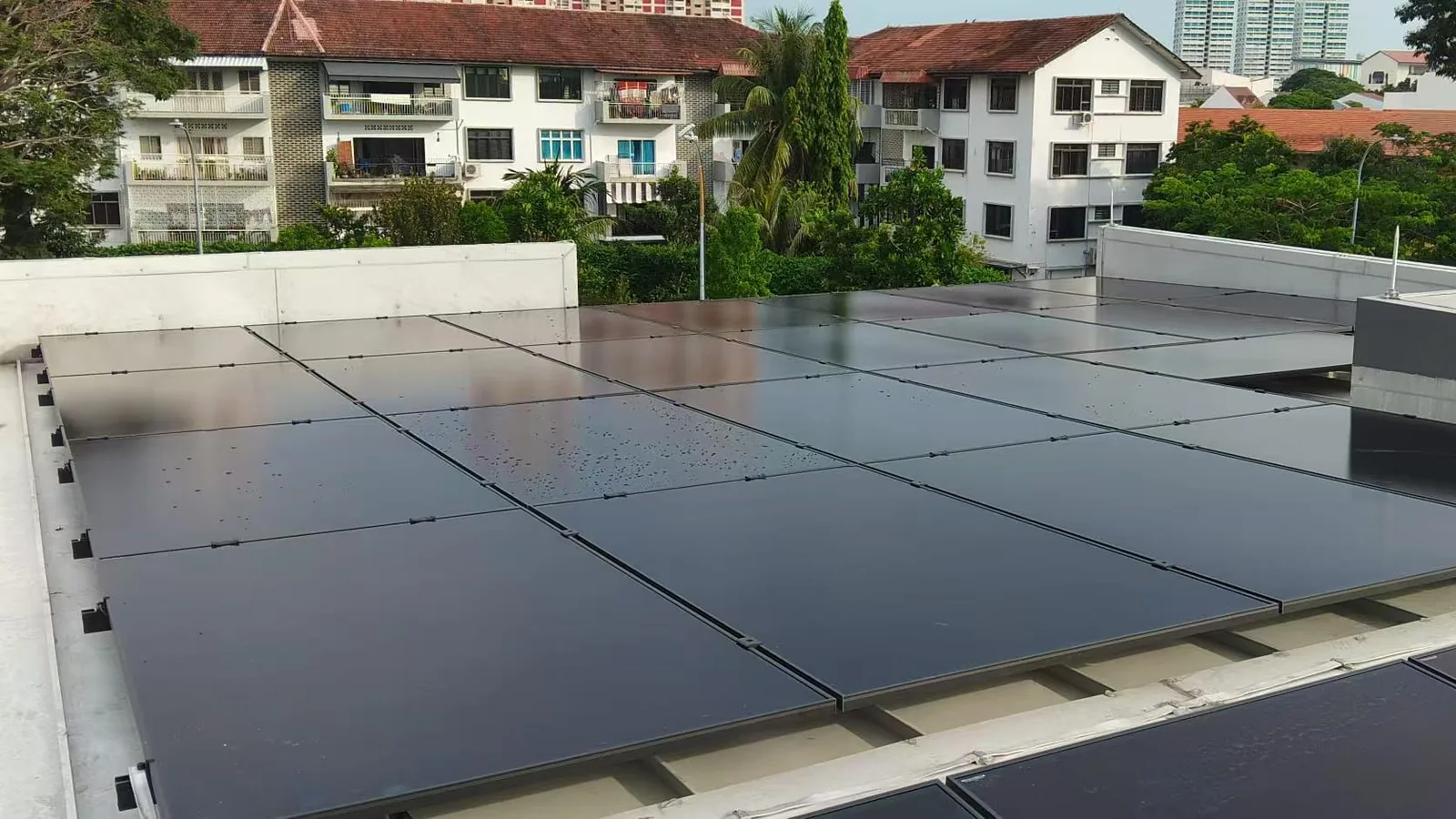
so the payment comes out to you, or you request a refund of the balance from SP Group, through the SP Utilities Portal, SP's online enquiry form or its customer service line. The step-by-step for both is below.
What happens to the electricity your panels export
Your solar generation is used by the house first. Only the surplus goes out to the grid, and you are paid for that surplus through a scheme SP Group calls the net export rebate.
How much you are paid depends on who you buy your electricity from, and that is the fork in the road that decides everything else on this page. It is also where most explanations of this topic go wrong.
Which scheme are you on, SP Group or a retailer?
There are two payment schemes, and the one that applies to you is decided by who sells you electricity, not by the size of your system.
You buy from SP GroupYou buy from a retailerYou areA non-contestable consumer, on the regulated tariffA contestable consumer. This includes ordinary households on an Open Electricity Market planSchemeSimplified Credit Treatment (SCT)Enhanced Central Intermediary Scheme (ECIS), registered with SP ServicesYou are paidThe regulated tariff minus the grid charge. Fixed, and reviewed each quarter. Roughly 22 cents against the 31.16 cents including GST that a unit costs to buy in the October to December 2026 quarterThe prevailing half-hourly wholesale electricity price, of which the Uniform Singapore Energy Price is a key component. Also excludes the grid charge. It varies through the day and has recently tended to sit below the SCT rate: one Rezeca customer on a retailer plan was recently paid about S$0.159 per kWh. EMA explains why the two rates differYour SP bill showsElectricity, water, waterborne tax, water conservation tax, refuse removal, gasNo electricity line. Water, waterborne tax, water conservation tax, refuse removal, gas
Worth correcting a common assumption here: ECIS is not a commercial-only or large-system scheme. If you are a household that switched to a retailer for a cheaper electricity plan, you are a contestable consumer and ECIS is the one that applies to you.
ECIS or SCT: which applies if you buy from a retailer?
ECIS applies. If a retailer sells you your electricity, your solar exports are paid under the Enhanced Central Intermediary Scheme at the half-hourly wholesale price. The Simplified Credit Treatment applies only to households that buy electricity from SP Group at the regulated tariff. You cannot stay with a retailer and choose SCT; moving your electricity supply back to SP Group is what moves you onto SCT.
What that difference is worth, using a real Rezeca figure: one Rezeca customer on a retailer plan was recently paid S$0.159 per kWh for exported solar, in the same period that SCT was paying about S$0.26. From October 2026 the SCT rate is roughly 22 cents. For a home exporting 300 kWh a month, that works out to about S$48 at the retailer-plan rate against about S$66 under SCT, a gap of roughly S$18 a month, or a little over S$200 a year.
Exporting 300 kWh a monthRate per kWhPer monthPer yearSCT (buying from SP Group, Oct to Dec 2026)about S$0.22about S$66about S$790ECIS (retailer plan, Rezeca customer example)S$0.159about S$48about S$570
Treat the retailer figure as one real data point rather than a fixed rate, because the wholesale price moves through the day and from month to month. The practical test is simple: a retailer plan still makes sense if its discount on the electricity you buy is larger than what you give up on the electricity you export. A home that uses most of its solar during the day exports less, so the gap matters less; a home that exports heavily should run the numbers before signing a retailer contract.
If you buy your electricity from a retailer
The plumbing is the same. The shape of it is not, and this catches people out.
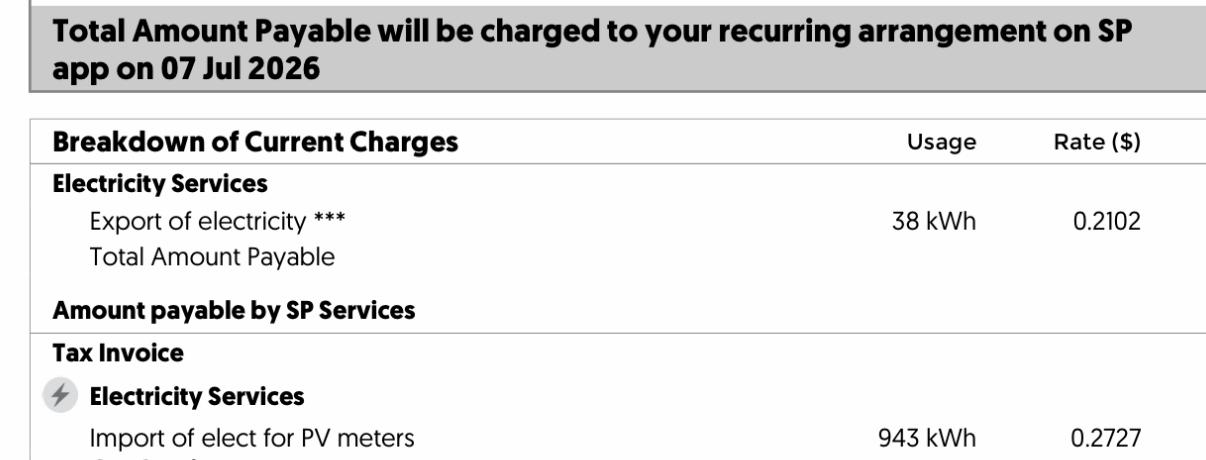
Your electricity usage is billed by your retailer. Your SP bill continues to arrive, but with the electricity line removed, so it carries water, the waterborne tax, the water conservation tax, refuse removal and gas where you have it. Your solar export rebate still comes through SP Services, because SP does the metering and administers the scheme, and it is still applied to your SP account.
Which means the rebate is now working against a much smaller bill. On a typical landed home the SP bill without electricity might be around S$95 a month, and in a sunny month the export rebate can exceed it. The bill reads zero and the surplus is stored, so a retailer customer accumulates a stored credit balance far faster than an SP customer does, and often without realising it, because the only bill they are actually reading is the one from the retailer.
If you switched to a retailer some time ago and have never looked at your SP bill closely, that is the first thing to check after reading this.
Two extra points that apply only on the retailer side. Contestable consumers with less than 10 MWac of solar also need to register with the Energy Market Company as a Market Participant. And if you would rather not be paid for exports at all, you can register the system as a Non-Exporting Intermittent Generation Facility, which removes the credit support and meter submission obligations but carries a fixed charge every six months instead. For a landed home that is rarely the right choice, but it exists.
Your solar rebate pays your water and refuse bill too
This is the part most people have not understood, and it applies whichever scheme you are on.
SP Services does not send you an electricity bill. It sends a single combined utilities bill, which is a tax invoice collecting charges on behalf of several organisations at once: electricity for SP Services and SP PowerAssets, water and NEWater charges plus the water conservation tax and the waterborne tax for PUB, refuse removal for whichever licensed collector serves your sector, gas for City Energy, and chilled water for SP Home Cooling where that applies.
Because it is one account with one total payable, your export rebate does not sit in a ring-fenced electricity pot. It works against the whole bill. Your panels are, quite literally, paying down your water and your rubbish collection.
Here is the cascade for a household buying electricity from SP Group. The figures are illustrative:
LineAmountRunning positionCredit balance brought forwardS$400.00S$400.00 availableThis month's net export rebateS$95.00S$495.00 availableElectricity consumedS$210.00S$285.00 leftWater, waterborne tax, conservation taxS$85.00S$200.00 leftRefuse removalS$10.00S$190.00 leftAmount payable this monthS$0.00S$190.00 stored, carried forward
Now run the same month for a household on a retailer plan. The S$210 electricity line is gone, billed by the retailer instead, so the S$495 available meets only S$95 of water and refuse. The bill reads zero and S$400 is stored rather than S$190. Same system, same generation, more than double the balance sitting on the account. To be clear, the retailer household is not better off: it pays its electricity bill to the retailer separately, and on a wholesale-linked export rate it may be earning less per unit exported. The balance is simply parked where fewer people look.
Two things follow. A bill reading zero is not the same as a bill reading zero with nothing behind it. And because the bill simply says zero, very few people look. Rezeca has sat with owners who were pleased about the zero and had not registered the four-figure balance parked behind it.
The option most owners miss: get paid by GIRO
Before you plan a refund request, check whether you need one at all.
When you register for the net export rebate, using SP's Net Export Rebate Application Form, you can also submit an Interbank GIRO application alongside it to receive the payment by GIRO. EMA sets this out on its own payment schemes page, and it applies to both SCT and ECIS.
That matters because it turns the whole thing from a manual chore into a standing arrangement. Most articles on this subject tell you there is no automatic payout and that you have to ask every single time. That is not what the source documents say. If your system was registered without a GIRO nomination, which is common, it is worth asking SP whether you can add one now rather than repeating a refund request every year.
Registration and the forms are handled at commissioning, normally submitted through SP Services' e-Business portal either directly or by your appointed Licensed Electrical Worker. Hard copies go to SP Group at 2 Kallang Sector, Singapore 349277. Enquiries about the registration itself go to install@spgroup.com.sg, which is a different address from the one for general solar questions.
If Rezeca installed your system, Rezeca submitted this application for you and passed you the application reference number once it was lodged. Keep it with your system documents. It is the quickest way for SP to find your registration, and if you have misplaced it, Rezeca can look it up for you.
Before you start: what to have ready
Five minutes here saves a rejected request later.
How to request your refund, step by step
You are asking SP Group to refund a credit balance on your utilities account. There are three routes. Start with the first.
Route 1: the SP Utilities Portal (start here)
This is self-service, it timestamps your request, and it leaves you a record.
Route 2: SP's written enquiry form
Use this when you want the request in writing, or when it is tangled up with a metering or export question rather than being a plain refund.
For questions about solar, export metering or how your rebate was calculated, write instead to powerfeedback@spgroup.com.sg, the address SP Group publishes for Solar PV enquiries and that EMA publishes independently in its solar FAQ. For questions about the rebate registration itself, including adding GIRO, use install@spgroup.com.sg.
Route 3: the phone
Use this if the portal route stalls, or if you would rather settle the payment method in one conversation.
SP Group also runs a customer service centre at HDB Hub in Toa Payoh if you would rather do this in person, though for a credit refund that is rarely necessary.
What to say: a request you can copy
Whichever written route you use, this covers everything SP needs on the first pass. Fill in the bracketed parts.
I would like to request a refund of the credit balance on my utilities account.
Account holder name: [exactly as it appears on the bill]
Premises address: [your address]
Credit balance: S$[amount] as at the bill dated [date]
The credit has accumulated from my solar net export rebate under the [Simplified Credit Treatment / Enhanced Central Intermediary] scheme. I would like to withdraw [the full balance / S$X of it].
Preferred payout method: [PayNow / bank transfer], registered in the same name as the account holder.
Please also advise whether a GIRO nomination can be added to my net export rebate so that future payments are made automatically, and confirm the expected processing date and a reference number for this request. Thank you.
If your request is rejected or stalls
What happenedLikely causeWhat to doRefund cannot be processed to your accountName mismatch. The receiving PayNow or bank account is not in the same name as the SP account holder.Either nominate a receiving account in the account holder's name, or change the SP account holder first. The latter is a separate request.The credit balance is lower than you expectedThe rebate has been absorbed by water, waterborne tax, refuse and gas charges, not only electricity.Read the full breakdown of charges rather than the electricity line alone. The stored balance is what is left after the entire bill.Your rebate rate moves around month to monthYou are on ECIS, paid at the half-hourly wholesale price, which varies with market conditions.Expected behaviour rather than a fault. Only the SCT rate is fixed between quarterly reviews.Exported units look wrong against your appAn estimated meter reading, or an export metering issue.Check whether that month was estimated. If the gap persists across actual readings, raise it with powerfeedback@spgroup.com.sg and tell your installer.Nothing has happened and no one has calledThe request is sitting in a queue, or was never logged.Follow up quoting your reference number and the date you submitted. This is why step six of Route 1 matters.
Why your credit can look wrong in some months
Worth knowing before you conclude something is broken. Many Singapore homes still have water and electricity meters that SP reads once every two months, and in the months between actual readings the bill may be based on an estimate unless you submit your own reading through the SP app. Most solar homes have a smart export meter that is read remotely, so an estimated electricity reading should be uncommon; if your bill is marked as estimated, it is worth asking SP why.
For a solar household that matters more than it does for everyone else, because an estimate has to guess both what you imported and what you exported. An estimated month can understate your rebate, or overstate it and then correct at the next actual reading. If your credit looks odd in one month and normal either side of it, check whether that month was estimated before raising it as a fault. Submitting your own readings in the off months removes the problem entirely.
Moving, selling, or changing the account holder
Deal with a stored credit balance before any of these, not after. A credit attached to an account you are closing is an avoidable complication, and an account being transferred to a new holder is exactly the situation that creates the name mismatch above.
If you are selling the property, the credit belongs to you rather than to the buyer, and it does not transfer with the house. Request the refund while the account is still open and still in your name.
A note on timing
You will find articles that publish a precise turnaround for each payout method, down to the number of working days. This guide leaves those out on purpose.
SP Group does not publish a service standard for this that can be pointed to, and the time taken varies with the payout method, whether your details are already verified, and the queue. Repeating someone else's anecdote as though it were policy is how a reader ends up frustrated on day eight of a "seven day" wait that was never a commitment in the first place.
The useful version is the one built into the steps above: ask SP for an expected date when you make the request, and write it down with your reference number. If the date passes, you have something specific to follow up on, which is worth considerably more than a figure you read on a website.
Where Rezeca fits
Rezeca Renewables has been installing solar in Singapore since 2009, with over 1,500 installations and 45+ MWp to date, including 1,300+ residential landed homes, so the team has walked a lot of owners through their first year of SP bills. The scheme registration, the net export rebate application and the export metering are all handled as part of commissioning, which Rezeca’s approvals checklist sets out in sequence.
The refund itself is between you and SP Group. Rezeca cannot request it on your behalf, and it is worth being wary of anyone who claims they can, because it is your utilities account and your money. What Rezeca can do is tell you which scheme your system was registered under, read the bill with you, and check the exported units against what your system actually produced before you spend an afternoon on it. If you would like a sense of what your system should be returning over its life, Rezeca’s ROI breakdown and payback guide set out the arithmetic. The rate moves every quarter: after the July 2026 tariff rise it eased 10.4% in October 2026, so a rebate in the last quarter of the year builds a little more slowly for exactly the same exported units. It is still about 5% above April to June 2026, though, and SP Group has warned it may rise again if fuel prices stay high.
Frequently asked questions
Not automatically. SP Group applies a net export rebate to your utilities account. That rebate is used against your bill, and only the amount left over is stored as a credit balance and carried forward. It becomes cash either when you nominate GIRO to receive the payment, or when you request a refund of the stored balance.
Yes. SP Services issues one combined utilities bill covering electricity, water, the waterborne tax and water conservation tax, refuse removal, and gas where you are connected. Because it is a single account with a single total payable, your solar export rebate is used against all of it, not just the electricity portion. Only what remains after the whole bill is covered is stored as a credit balance.
Your electricity is billed by the retailer, so your SP bill has no electricity line and carries only water, the waterborne tax, the water conservation tax, refuse removal and gas. The export rebate still comes through SP Services and is still applied to that SP account, so it is offsetting a much smaller bill and the stored credit balance builds up considerably faster. You are on the Enhanced Central Intermediary Scheme rather than the Simplified Credit Treatment, which means you are paid the prevailing half-hourly wholesale electricity price rather than a fixed rate, so your rebate varies with market conditions and can be well below the SCT rate. You are not better off overall, because your electricity is billed separately by the retailer.
If you buy your electricity from a retailer, ECIS applies, and your solar exports are paid at the half-hourly wholesale electricity price. SCT applies only if you buy electricity from SP Group at the regulated tariff, and you cannot choose SCT while staying with a retailer. One Rezeca customer on a retailer plan was recently paid S$0.159 per kWh for exports, against roughly 22 cents under SCT from October 2026. A retailer plan still makes sense if its discount on the electricity you buy outweighs what you give up on exports.
No. ECIS applies to any contestable consumer, which includes an ordinary household that has switched to an electricity retailer on an Open Electricity Market plan. The scheme is decided by who sells you electricity, not by the size of your system. Contestable consumers with less than 10 MWac also need to register with the Energy Market Company as a Market Participant.
You can nominate GIRO to receive the payment. EMA's payment schemes page directs consumers to submit an Interbank GIRO application together with SP's Net Export Rebate Application Form, and this applies under both the Simplified Credit Treatment and the Enhanced Central Intermediary Scheme. If your system was registered without a GIRO nomination, ask SP Group whether one can be added rather than repeating a manual refund request. Enquiries about the rebate registration go to install@spgroup.com.sg.
Request a refund of the credit balance on your utilities account. The self-service route is the Manage Refund Request tool in the SP Utilities Portal. You can also submit SP Group's online enquiry form under SP Services, Enquiries on Utilities Account, choosing the billing and payment subject and the refund option, or call SP Group's customer service line printed on your bill, with your account number and your application reference number (your installer can give you this) ready. For solar-specific questions, SP Group and EMA both publish powerfeedback@spgroup.com.sg. Ask for a reference number and an expected date.
The most common reason is a name mismatch. The PayNow or bank account receiving the money has to be registered in the same name as the SP utilities account holder. If the utilities account is in a different name from the receiving account, whether a spouse, a previous owner or a tenant, the refund cannot be processed until the account holder details are corrected.
SP reads utilities meters once every two months, and bills in between may be estimated unless you submit your own reading through the SP app. An estimated month can understate or overstate your rebate, and it corrects at the next actual reading. If you are on ECIS, the rate itself also varies with the half-hourly wholesale price, so some month-to-month movement is normal. If a gap persists across actual readings, raise it with SP Group and tell your installer.
The credit belongs to you, not to the buyer, and it does not transfer with the property. Request the refund while the utilities account is still open and still in your name. Dealing with a stored balance before you close or transfer an account avoids both the loss and the name-mismatch problem that comes with a change of account holder.
Not sure whether your bill is telling you something?
If your rebate looks smaller than you expected, or the numbers on your bill do not line up with what your monitoring app reports, send Rezeca the bill and a screenshot of the app and the team will read them against each other. If you are on a retailer plan and have not looked at your SP bill in a while, that is worth a check too. Sometimes the answer is that the rebate has quietly been paying your water and refuse all year. Sometimes it points at something worth fixing.
Rezeca Renewables has installed solar for landed homes and businesses across Singapore since 2009, with over 1,500 installations and 45+ MWp to date, including 1,300+ residential landed homes.
Considering solar for your Singapore home?
Rezeca offers a free on-site assessment, no-obligation quotes, and full 25-year ROI projections based on your actual property. Own your system outright or finance it through UOB U-Solar, backed by 17 years of experience and 1,300+ landed-home installations.
Estimate your savingsWhatsApp:+65 9839 9044 | Email:enquiry@rezeca.com
All your solar questions, answered
Everything Singapore landed homeowners need to know about solar panel installation, costs, approvals, and returns.
Get Your Custom
Solar Plan
Prefer to chat? Tap the WhatsApp icon below to reach our team instantly.

Copyright © 2026 Rezeca Renewables.