How to Read a Solar Quotation in Singapore: What to Check Before You Sign
Solar quotes are written to wildly different standards, which is why the lowest one is often the most expensive outcome. Here is what a complete quotation shows, and the lines to check before you sign.

The quick answer: A solar quotation you can actually trust shows five things plainly: the system size in kWp, the exact panel and inverter make and model, an expected annual generation figure with the assumptions behind it, a clear list of what the price includes and excludes, and separate warranties for the panels, panel performance, the inverter and the workmanship. If a quote gives you a headline price and a system size but not the rest, you cannot compare it with anything, and that is usually the point. Residential systems in Singapore run about S$1,200 to S$2,000 per kWp in 2026, so a price far below that range is a signal to look harder at what has been left out, not a bargain. Get the quotes onto a like-for-like footing first, and the price question becomes much easier to answer.
Why are solar quotes so hard to compare?
Homeowners often gather three quotes and find they cannot line them up. One is a single page with a number. Another runs to twelve pages of specifications. A third quotes a monthly figure rather than a price. They rarely use the same system size, the same assumptions, or the same scope of work, so the cheapest-looking number can easily be the most expensive outcome.
The difficulty is not that solar is complicated. It is that quotes are written to different standards. Once you know which five things to look for, comparing becomes straightforward, and the gaps in a weaker quote become obvious quickly.
Compare like for like, then talk about price
It is tempting to skip to the last page. When three documents are full of unfamiliar terms, the final figure feels like the one honest, comparable number in the whole thing. It is also the number most easily engineered downward, by quoting a smaller system, cheaper components, or a scope that quietly leaves out work you will still have to pay for later.
So before comparing totals, put the quotes side by side on four things: system size in kWp, panel and inverter model, what is included in the scope, and the warranties. If those four match, the prices are genuinely comparable. If they do not, you are not comparing quotes, you are comparing different projects.
Once you are on that footing, Rezeca would rather have the conversation openly: if you have an offer that genuinely matches a Rezeca proposal on system size, equipment and scope, share it and Rezeca will look at matching it. What Rezeca will not do is meet a lower number by taking something out of the scope and not mentioning it. That is the version of a discount that shows up as a variation order later, or as a problem on your roof in year seven.
What should be on the first page?
Before any pricing makes sense, the quote has to tell you what you are actually buying.
System size in kWp. This is the array's rated capacity, and it is the number everything else scales from. A quote without it cannot be compared on price.
Panel make, model, wattage and count. "Tier 1 panels" is not a specification. You want something like "36 x Aiko 470 Wp", because the brand, the wattage and the cell technology all affect output, appearance and warranty. Rezeca's panel brand comparison covers what the differences mean in practice.
Inverter make, model and quantity. The inverter is the component most likely to need replacing within the system's life, so the brand and warranty matter. Note whether optimisers or microinverters are included, which matters a great deal on a shaded roof.
A roof layout. A drawing or satellite overlay showing where the panels go. Without it, nobody has confirmed the panels actually fit around your skylights, water tanks and plant.
Expected annual generation, in kWh. With the assumption stated. In Singapore, a reasonable yield assumption sits between about 1,100 and 1,350 kWh per kWp per year, depending on shading, orientation and the weather in any given year. A quote assuming a figure above that range is flattering its own savings numbers.
What does the price actually include?
This is where quotes diverge most, and where a low headline price usually comes from. Ask for the inclusions and exclusions in writing, and check specifically for these:
- Licensed Electrical Worker (LEW) certification. Legally required. If it is not in the quote, you will be paying for it separately.
- The SP Group application and bi-directional meter. Needed before you can export power and be credited for it.
- Scaffolding or access equipment. Often a meaningful cost on a tall or awkward house, and a common exclusion.
- Distribution board work and cable routing. Including whether cables will be concealed or surface-run, which affects both cost and how the finished job looks.
- Structural endorsement by a Professional Engineer, where the roof or system size calls for it.
- Mounting system and waterproofing details, especially on a tile roof, where the mounting method is what protects you against leaks.
- Monitoring hardware and app setup.
- GST. Check whether the figure quoted is before or after.
Two quotes can differ by thousands of dollars purely on which of these sit inside the price and which appear later as variations. The comparison you want is not price against price, it is price against the same scope.
What about the parts you never see?
Panels and inverters get all the attention, because they are the two lines every quote names. But a solar system is also made of components nobody photographs, and they are a common place for a lower price to come from.
DC cabling. The cable running from your panels to the inverter sits on a hot roof, in full sun and heavy rain, for decades. Solar-rated cable from a reputable manufacturer is built for that UV and temperature exposure. Cheaper generic cable is not, and cable that degrades is both a performance problem and a fire risk. Ask which brand is being used.
Mounting rails and clamps. These carry the entire array through years of monsoon wind and salt-laden air. Marine-grade aluminium and stainless fixings resist corrosion in Singapore's climate; lesser alloys and coated steel do not, and a corroding clamp is a loose panel. The mounting system is also what determines whether a tile roof stays watertight.
Roof penetration and waterproofing detail. How each fixing point is sealed is the difference between a roof that is fine in twenty years and one that leaks in three. It is rarely itemised, and it is worth asking about specifically.
None of this is glamorous, and none of it shows in a photograph of a finished roof. It is, however, most of what decides whether the system is still performing properly in year twenty. You do get what you pay for here: better components cost more upfront and last considerably longer, and on a system meant to run for 25 to 30 years, that trade is usually worth making. If one quote is meaningfully cheaper than another on the same panels and inverter, the balance of system is one of the first places to look for the difference.
How should I read the warranties?
"25-year warranty" on its own tells you almost nothing, because there are several different warranties in a solar system and they are not interchangeable.
Panel product warranty. Covers manufacturing defects in the panel itself. Most quality panels sold for Singapore homes now carry 25 or 30 years, though some budget lines still offer 12 to 15, so check the datasheet.
Panel performance warranty. A guarantee that output will not fall below a stated percentage of the original rating by a given year, commonly around 87 to 92 percent at year 25. This is separate from the product warranty and usually longer.
Inverter warranty. Typically 5 or 10 years depending on model, and often extendable. Since inverters are the most likely component to need replacement, this one carries real financial weight.
Workmanship warranty. The installer's own cover for the installation: mounting, waterproofing, cabling. This is the one that protects you against a roof leak, and it is the one most often left vague.
The question worth asking directly is who honours each warranty and how a claim is actually made. A manufacturer warranty is only as useful as the company that will file it on your behalf and get on your roof to do the work. That is a fair question to put to any installer, including Rezeca.
Who will still be there in ten years?
This is the part of a quotation that never appears on the page, and it has become one of the most important questions to ask.
Singapore's solar market grew quickly, and not every company that entered it has stayed. Rezeca hears from a rising number of homeowners whose systems were installed by other companies over the past five years, who now cannot reach anyone: the installer has wound down or closed, the phone number is dead, and the warranty they were sold has nobody left to honour it. They come to Rezeca for troubleshooting, inverter faults, monitoring that stopped reporting, or repairs after a leak. The team helps where it can, though picking up another company's installation is harder and costs more than it would have if Rezeca had built it, because the team is working backwards through decisions it did not make and documentation that often no longer exists.
A 25-year warranty is a promise about the next 25 years, so it is only worth what the company behind it is worth. Before you sign, it is reasonable to ask how long the installer has been trading, how many systems they have completed, whether the installation team is in-house or subcontracted, and who you actually call in year eight. Rezeca Renewables has been installing solar in Singapore since 2009, 17 years, with over 1,500 installations and an in-house team, which is Rezeca's honest answer to that question. Ask every installer you are considering the same one.
How do I sanity-check the savings figures?
Savings projections are where quotes flatter themselves most, because small changes to the assumptions produce large changes to the headline number. Ask which figures were used:
- The tariff. For the October to December 2026 quarter the regulated tariff is 31.16 cents per kWh including GST. A projection built on a higher assumed tariff will overstate savings.
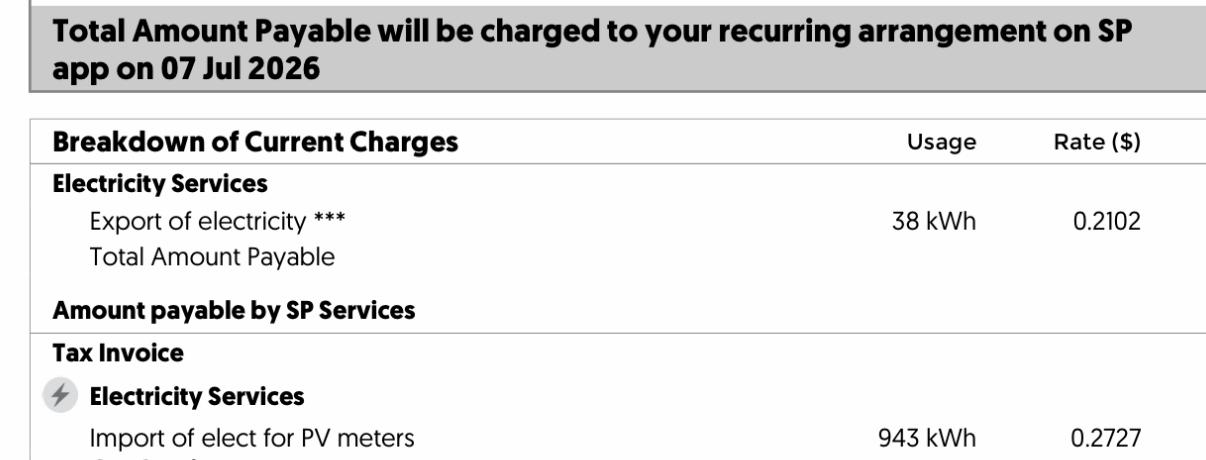
- The export rate. Surplus power is credited under the Simplified Credit Treatment scheme at about S$0.22 per kWh, noticeably less than the roughly S$0.31 you avoid paying by using the power yourself. Retailer plans set their own export rate, which can be lower still.
- The self-consumption split. This is the assumption that moves the number most. A projection assuming you use 80 percent of your generation during daylight will look far better than one assuming 40 percent, and if nobody is home during the day, the lower figure is the honest one.
- Annual degradation. Panels lose a small fraction of output each year, typically around 0.4 to 0.6 percent. A projection with no degradation at all is not a real projection.
- Assumed tariff inflation. Some quotes escalate the tariff by a few percent a year across 25 years, which compounds into a very large savings figure. That may or may not happen. Ask to see the numbers without escalation too.
A quote that hands you the assumptions without being asked is telling you something good about how it was put together. Rezeca's honest ROI breakdown walks through the same arithmetic from first principles.
What does a normal payment schedule look like?
Staged payments tied to milestones are standard: a deposit on signing, a payment as materials are ordered or works begin, and a final payment on commissioning and handover. What is worth questioning is a demand for the full amount upfront, or a very large deposit with no milestone attached to the balance. You want a meaningful portion of the money still outstanding at the point the system is switched on and proven to work.
Also check the stated lead time. From contract to switch-on, four to twelve weeks is normal in Singapore, and much of that is the SP Group connection timeline rather than the installer's own work. Rezeca's guide to solar approvals explains who is waiting on whom.
A line-by-line checklist
| On the quote | What a complete answer looks like | What to ask if it is missing |
|---|---|---|
| System size | Stated in kWp, with panel count and wattage | "What is the kWp, and how many panels of what wattage?" |
| Equipment | Named panel and inverter models, not tiers or categories | "Which exact models, and can they change before installation?" |
| Price per kWp | Within roughly S$1,200 to S$2,000 for residential | "What is excluded that explains the difference?" |
| Inclusions | LEW, SP application, meter, scaffolding, DB work, GST all addressed | "Please list what is excluded and likely to be charged later." |
| Generation | Annual kWh with the yield assumption shown | "What kWh per kWp did you assume, and why?" |
| Savings | Tariff, export rate, self-consumption split and degradation all stated | "Can I see this without tariff escalation?" |
| Balance of system | DC cable brand, mounting rails and clamps named, with waterproofing detail | "Which cable, rails and clamps, and how is each fixing sealed?" |
| Warranties | Product, performance, inverter and workmanship listed separately | "Who honours each one, and how do I claim?" |
| Payment | Staged against milestones, balance due at commissioning | "What is still outstanding when the system is switched on?" |
Figures are 2026 guidance for Singapore landed homes. Your own quote should reflect your roof, usage and equipment choice.
What are the warning signs?
A few patterns are worth pausing on. None is proof of a bad installer, but each deserves a straight answer before you sign.
- A price with no system size, no equipment model, or no breakdown of inclusions.
- Pressure to sign quickly, or a discount that expires within days.
- Savings projections with no stated assumptions, or with a self-consumption rate nobody discussed with you.
- A single blanket "25-year warranty" covering everything, with no separation between panel, inverter and workmanship.
- Full payment or a very large deposit demanded before any work happens.
- No site visit before a firm price is given. A satellite estimate is fine for an indication, not for a contract.
- Subcontracted installation where nobody will say who is actually coming to your roof, or who carries the workmanship warranty afterwards.
Frequently asked questions
What should a solar quotation in Singapore include?
System size in kWp, the exact panel and inverter make and model with panel count, a roof layout, expected annual generation with its yield assumption, a clear list of inclusions and exclusions covering LEW certification and the SP Group application, separate product, performance, inverter and workmanship warranties, a staged payment schedule, and an expected timeline.
How much should solar cost per kWp in Singapore?
Residential landed-home systems generally run about S$1,200 to S$2,000 per kWp in 2026, with the lower per-kWp figures on larger systems because design, approvals and connection costs do not scale with panel count. A price well below that range usually means something has been excluded from the scope.
Why are two solar quotes for the same house so different?
Usually because they are not quoting the same thing. Different system sizes, different equipment, and above all different scope: one may include scaffolding, LEW certification, the SP Group application and concealed cabling while the other leaves them out to be charged later. Compare scope first, then price.
How do I check if the savings figures in a solar quote are realistic?
Ask for four assumptions: the yield in kWh per kWp (roughly 1,100 to 1,350 in Singapore), the tariff used (the current SP Group tariff, which is 31.16 cents per kWh including GST for October to December 2026), the export rate (about S$0.22 for SP Group customers under the Simplified Credit Treatment scheme; retailer plans set their own rate, which can be much lower, such as S$0.159), and the assumed self-consumption split. Also ask to see the projection without any tariff escalation.
Will a solar installer match a lower quote?
Many will consider it where the offer is genuinely like for like. That means the same system size in kWp, the same panel and inverter models, the same scope of work, and the same warranties. Rezeca will look at matching a comparable offer on that basis. Be cautious of any installer who meets a lower price without saying what changed, because the reduction usually comes out of the scope or the component quality rather than the margin.
What happens to my warranty if my solar installer goes out of business?
Manufacturer warranties on the panels and inverter remain valid, but you lose the company that would file the claim and do the work, and the installer's own workmanship warranty ends with the business. In practice, homeowners in this position have to find another company willing to take on a system it did not install, which costs more and takes longer because the original design decisions and documentation are often unavailable. This is why an installer's trading history and track record are worth weighing alongside the price.
Should I pay the full amount for solar upfront?
No. Staged payments tied to milestones are standard: a deposit on signing, a payment at materials or works commencement, and the balance on commissioning and handover. Keeping a meaningful sum outstanding until the system is switched on and verified protects you.
Want a second opinion on a quote you already have?
If you are holding two or three quotes and cannot line them up, Rezeca is happy to look at what you have and explain what each one is and is not covering, whether or not you end up working with Rezeca. Choosing well matters more than choosing quickly. Book a free site assessment and Rezeca will put a like-for-like proposal next to what you already have, with the assumptions shown. For a first estimate, try the solar savings calculator, see how residential solar installation works with Rezeca, or read the guides on solar panel cost, how many panels your home needs and how to choose an installer.
Rezeca Renewables has installed solar for landed homes and businesses across Singapore since 2009, with over 1,500 installations and 45+ MWp to date, including 1,300+ residential landed homes.
Considering solar for your Singapore home?
Rezeca offers a free on-site assessment, no-obligation quotes, and full 25-year ROI projections based on your actual property. Own your system outright or finance it through UOB U-Solar, backed by 17 years of experience and 1,300+ landed-home installations.
Estimate your savingsWhatsApp:+65 9839 9044 | Email:enquiry@rezeca.com
All your solar questions, answered
Everything Singapore landed homeowners need to know about solar panel installation, costs, approvals, and returns.
Get Your Custom
Solar Plan
Prefer to chat? Tap the WhatsApp icon below to reach our team instantly.

Copyright © 2026 Rezeca Renewables.