11
min read
· Written by
Angela
June 6, 2026
Is Solar Worth It in Singapore? The Honest ROI, Savings & Payback Guide (2026)
How to assess solar savings and simple payback for a Singapore landed home, using the updated calculator assumptions and clearly separated lifetime costs.

Quick answer: Solar can reduce purchases from the grid and earn export proceeds, but financial returns depend on the property and quoted cost. For a 20 kWp reference system and S$600 monthly electricity-only bill, the calculator gives 22,000 kWh annual generation: 15,400 kWh used on site avoids S$4,799 of purchases and 6,600 kWh exported earns S$1,452. First-year total benefit is S$6,251. The indicative initial cost is S$24,000 to S$40,000, with S$32,000 midpoint cost and 5.1-year simple payback, or 3.8 to 6.4 years across that cost range. These are scenario results, not a typical outcome for every home.
Reviewed by Justin Tan, Lead Engineer. Published 3 June 2026. Last verified 4 October 2026.
Key facts (last verified 4 October 2026)
- Simple payback: property-specific; the worked examples below use explicit cost, generation and tariff assumptions.
- Lifetime benefit: gross proceeds, initial cost and future operating costs must be shown separately; no blanket return multiple applies.
- Residential price: S$1,200 to S$2,000 per kWp (2026)
- Q4 2026 assumptions: S$0.3116/kWh regulated import including GST; S$0.22/kWh rounded SCT export illustration for eligible customers.
- Rezeca track record: 1,300+ residential installations since 2009 (verified)
Whether solar makes financial sense depends on your quote, roof and electricity use. Compare the first-year benefit with the installed cost, then assess maintenance, replacements, degradation and future tariffs over the period you expect to own the system.
This guide separates avoided electricity purchases from export proceeds and explains simple payback and lifetime-cost limitations. Reference examples use the dated calculator assumptions below; project-specific quotations can differ. Related reading: 1,300+ landed-home installations
How much does solar save a Singapore landed home?
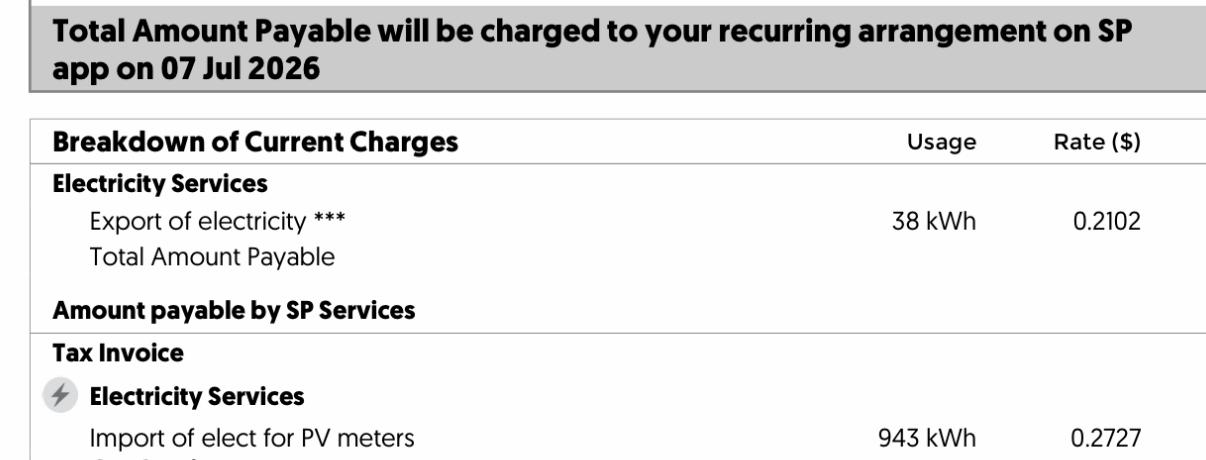
Only solar used on site avoids electricity purchases at your import tariff. Surplus solar has a separate export value under the eligible payment arrangement. Generation, bill reduction and total financial benefit are different quantities.
The following calculator scenarios illustrate first-year benefit under the stated assumptions:
| Property example | Size | Monthly electricity-only bill | Annual generation | Purchases avoided | Export proceeds | Year-1 total benefit |
|---|---|---|---|---|---|---|
| Terrace example | 12 kWp | S$400 | 13,200 kWh | S$2,879 | S$871 | S$3,750 |
| Semi-detached example | 22 kWp | S$600 | 24,200 kWh | S$5,279 | S$1,597 | S$6,876 |
| Bungalow example | 30 kWp | S$800 | 33,000 kWh | S$7,198 | S$2,178 | S$9,376 |
| GCB example | 65 kWp | S$1,500 | 71,500 kWh | S$15,596 | S$4,719 | S$20,315 |
Two things drive the variation: how much of the solar you use directly (self-consumption is worth more than export), and your daytime load. Homes with pool pumps, aircon running during the day, EVs charging, or domestic helpers home during work hours capture more value. Real-world generation is also affected by Singapore's tropical heat. Panels rated at 25°C operate at 55 to 70°C on local roofs, which is factored into the figures above.
Future electricity prices are uncertain. A higher import tariff increases the value of solar used on site, while a lower tariff reduces it; export prices may follow a different mechanism. The illustrations do not assume automatic annual tariff inflation.
How these illustrations are calculated (checked 18 October 2026)
- System cost: S$1,200 to S$2,000 per kWp (2026), lower per kWp on larger roofs
- Reference annual yield: 1,100 kWh/kWp, before site-specific orientation and shading adjustments.
- Import: S$0.3116/kWh including GST in Q4 2026. Export: S$0.22/kWh rounded SCT illustration for eligible regulated-tariff customers; retailer / ECIS assumptions differ.
- On-site use: 70% of generation in these examples, with the stated bill sufficient to support that annual use. Actual simultaneous consumption requires interval load data.
- Result: the examples give 5.1-year midpoint simple payback, or 3.8 to 6.4 years over the displayed cost range. Equal payback across these examples follows from using the same cost per kWp, yield and on-site share; it is not evidence that all homes perform alike.
- Your figure will differ, every Rezeca quote uses your actual roof, usage and equipment
These are planning estimates, not a guarantee. Verified company facts (installations, capacity, rating) are stated separately.
How long is the solar payback period in Singapore?
There is no fixed payback period for a Singapore landed home. It depends on quoted installed cost, roof yield, shading, actual on-site use and applicable import/export rates. A larger system does not automatically pay back faster. Use the calculator for an adjustable, dated illustration and obtain a roof and load-profile assessment.
For a 20 kWp reference system and S$600 monthly electricity-only bill, the calculator gives 22,000 kWh annual generation: 15,400 kWh used on site avoids S$4,799 of purchases and 6,600 kWh exported earns S$1,452. First-year total benefit is S$6,251. The indicative initial cost is S$24,000 to S$40,000, with S$32,000 midpoint cost and 5.1-year simple payback, or 3.8 to 6.4 years across that cost range. These are scenario results, not a typical outcome for every home.
| Property example | Size | Illustrative initial cost range | Midpoint cost | Simple payback at midpoint |
|---|---|---|---|---|
| Terrace example | 12 kWp | S$14,400 to S$24,000 | S$19,200 | 5.1 years (illustration) |
| Semi-detached example | 22 kWp | S$26,400 to S$44,000 | S$35,200 | 5.1 years (illustration) |
| Bungalow example | 30 kWp | S$36,000 to S$60,000 | S$48,000 | 5.1 years (illustration) |
| GCB example | 65 kWp | S$78,000 to S$130,000 | S$104,000 | 5.1 years (illustration) |
System size alone does not determine payback. A larger array can have a lower quoted cost per kWp, but it can also export a greater share if daytime demand is limited. Compare the actual quote, roof yield and load profile rather than assume every larger home earns a faster return.
Solar may continue reducing electricity purchases and earning export proceeds after the initial cost is recovered. Those benefits are not cost-free profit: degradation, maintenance, inverter replacement and future tariffs affect the result. Warranty length does not establish system payback or eliminate running costs.
The full cost picture, including what is and is not included in a quotation, is covered in our 2026 cost guide.
What is the 25-year ROI on solar in Singapore?
The table below is a 25-year arithmetic illustration at unchanged output and tariffs. Gross benefit is annual benefit multiplied by 25; the balance subtracts only the initial midpoint cost. Neither figure is net profit or investment ROI, because future running costs, replacements, degradation, financing and discounting are excluded. Related reading: Tier-1 solar panels
| Property example | 25-year gross benefit | Initial midpoint cost | Balance after initial cost, before upkeep and degradation |
|---|---|---|---|
| Terrace example | S$93,760 | S$19,200 | S$74,560 |
| Semi-detached example | S$171,893 | S$35,200 | S$136,693 |
| Bungalow example | S$234,399 | S$48,000 | S$186,399 |
| GCB example | S$507,865 | S$104,000 | S$403,865 |
These figures hold output and tariffs constant. They exclude degradation, maintenance, inverter replacement, financing and discounting. They are gross-benefit illustrations, not net investment returns or forecasts of future tariff increases.
What are the risks of installing solar?
We would rather you know these going in than discover them later.
Inverter replacement and maintenance are real lifecycle costs. The simplified calculator balances do not include them. Obtain a separate equipment-specific allowance and include future replacements, degradation, finance and discounting before treating a long-term projection as net investment return. Related reading: Inverter replacement and annual maintenance costs
Policy and tariff shifts. The share of benefit from avoided purchases and exports depends on actual on-site consumption and applicable prices. In these reference examples, 70% on-site use supplies about 77% of first-year financial benefit; exports supply about 23%. Import and export prices can change independently, and neither is guaranteed to rise.
Shading. A neighbour's renovation or a fast-growing tree can clip your generation. This is why we do a pre-installation shading analysis before quoting. If there is a future risk, you should know about it now, not in year three.
Roof condition. If your roof is more than 20 years old and likely to need replacement within the next decade, do the roof first. Removing and reinstalling panels mid-system-life is workable but adds cost. Roof type matters too. Tile, metal, and RC roofs each have different mounting requirements.
Does solar increase property value in Singapore?
A solar system may appeal to buyers who value lower running costs, but this calculation does not assume a resale premium. Property value depends on the market, system condition, ownership and warranty transfer terms.
It is not the reason to install solar. But it is worth knowing the asset you are adding is one the next owner will pay for too.
When is solar not worth it?
An honest list:
- Your roof is heavily shaded by adjacent buildings or mature trees with no pruning option.
- Your electricity bill and daytime demand are low relative to the proposed array. Check the resulting export share, payment arrangement and system size; a bill threshold alone does not establish a particular payback period.
- You are planning to sell within two to three years and the buyer pool for your property does not particularly value solar.
- The roof is at end of life and you are not planning to replace it.
If any of these apply to you, we will tell you. A site visit is the only way to give you a real number, not a calculator estimate.
What to do next
The honest next step is a site visit. We look at your roof orientation, shading, electrical setup, and your last 12 months of SP bills, then give you the actual numbers for your home, not a range.
It takes about an hour, and you get a written proposal with exact system size, cost, year-one savings, and 25-year projection. No commitment, no follow-up sales pressure.
Two reads worth your time before the site visit. Our complete guide to solar on Singapore landed homes covers system sizing, equipment, and regulatory approvals. The honest comparison of Singapore solar installers walks through what actually differentiates one company from another. And if you want the full pricing breakdown by home type, the 2026 cost guide has the numbers.
Sources: SP Group (tariff and export), EMA (solar approvals), and the National Solar Repository of Singapore.
Considering solar for your Singapore home?
Rezeca offers a free on-site assessment, no-obligation quotes, and full 25-year ROI projections based on your actual property. Own your system outright or finance it through UOB U-Solar, backed by 17 years of experience and 1,300+ landed-home installations.
WhatsApp: +65 9839 9044 | Email: enquiry@rezeca.com | Web: rezeca.com
Assumptions and limits
Q4 2026 illustration, checked 18 October 2026: SP regulated household import at S$0.3116/kWh including GST, effective 1 October to 31 December; rounded SCT export illustration of S$0.22/kWh for eligible regulated-tariff customers; reference yield of 1,100 kWh/kWp a year; 70% on-site use with sufficient household demand; and indicative installed cost of S$1,200 to S$2,000/kWp, using S$1,600/kWp for midpoint payback. These are the calculator assumptions, not a quotation, measured project result or guaranteed return. Retailer / ECIS customers must use their applicable import and export assumptions. Simple payback divides initial installed cost by first-year avoided electricity purchases plus export proceeds. It excludes future operating costs. Long-term illustrations hold tariffs and output constant and exclude degradation, maintenance, inverter replacement, finance, RECs and discounting. A panel warranty is separate from these costs.
Adjust the calculator assumptions · SP Group tariff · EMA solar payment schemes
Further questions
Is it cheaper to buy solar outright or take a monthly or rent-to-own plan?
Over the full term, buying usually costs less in total. Monthly and rent-to-own plans lower the upfront cost but add a premium over time and may delay ownership. For most Singapore landed homes, owning outright, with a credit card or installment if it helps, gives the best lifetime value. Ask us to model both options for your home so you can compare the total cost.
Does Rezeca offer installment plans for solar?
Yes. We offer installment options so you can spread the cost over time while owning the system from day one. Our sales team will walk you through the details that suit your situation.
Can I pay for my solar system with a credit card?
Yes. You can pay by credit card and still own the system outright. Ask our team about card payment when we prepare your proposal.
Do I have to pay for solar panels upfront in Singapore?
No. You can pay for your solar system outright, or spread the cost with a credit card or an installment plan while still owning the system from day one. Owning your system gives the best lifetime savings, because you keep all of the electricity savings and export credits. Speak to our team about the payment option that suits you.
Does Rezeca offer rent-to-own or $0-upfront solar?
Our recommendation for landed homeowners is to own the system outright, because it keeps the fastest and largest return with you. If financing is genuinely the only way a project can go ahead, we are happy to talk through the options, and we will always show you the ownership comparison first. If upfront cost is the only obstacle, paying by credit card or a bank instalment plan usually works out better than rent-to-own, because you still own the system from day one.
Considering solar for your Singapore home?
Rezeca offers a free on-site assessment, no-obligation quotes, and full 25-year ROI projections based on your actual property. Own your system outright or finance it through UOB U-Solar, backed by 17 years of experience and 1,300+ landed-home installations.
Estimate your savingsWhatsApp:+65 9839 9044 | Email:enquiry@rezeca.com

All your solar questions, answered
Everything Singapore landed homeowners need to know about solar panel installation, costs, approvals, and returns.
Over the full term, buying usually costs less in total. Monthly and rent-to-own plans lower the upfront cost but add a premium over time and may delay ownership. For most Singapore landed homes, owning outright, with a credit card or installment if it helps, gives the best lifetime value. Ask us to model both options for your home so you can compare the total cost.
Yes. We offer installment options so you can spread the cost over time while owning the system from day one. Our sales team will walk you through the details that suit your situation.
Yes. You can pay by credit card and still own the system outright. Ask our team about card payment when we prepare your proposal.
No. You can pay for your solar system outright, or spread the cost with a credit card or an installment plan while still owning the system from day one. Owning your system gives the best lifetime savings, because you keep all of the electricity savings and export credits. Speak to our team about the payment option that suits you.
Our recommendation for landed homeowners is to own the system outright, because it keeps the fastest and largest return with you. If financing is genuinely the only way a project can go ahead, we are happy to talk through the options, and we will always show you the ownership comparison first. If upfront cost is the only obstacle, paying by credit card or a bank instalment plan usually works out better than rent-to-own, because you still own the system from day one.
Get Your Custom
Solar Plan
Prefer to chat? Tap the WhatsApp icon below to reach our team instantly.

Singapore’s pioneer in residential and commercial solar installations since 2009.